

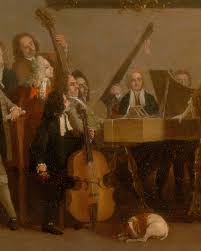
June is the sixth month in the Gregorian calendar, which is the calendar most in use throughout the world. This June, the Daily Classical Music Post will explore chamber music, choral music, and operatic sextets from the Renaissance to the 21st century.
Telemann: String Sextet in F Minor, TWV. 44:32 – II. Allegro
The German Baroque composer Georg Philipp Telemann (1681–1767) was an incredibly prolific composer: his catalogue contains upwards of 3,000 works. Telemann, who was largely self-taught, wrote operas, cantatas, oratorios, chamber music, orchestral suites, and concertos, and all of his music was highly regarded in his lifetime. He also highly regarded himself; he published a music periodical devoted to the promotion of his own music, which gave him international fame. Some musicologists describe Telemann as the rock star of his day.
The most popular of his compositions today include his Tafelmusik (which we explored a couple of years ago here on the DCMP: https://dailyclassicalmusicpost.com/2024/04/02/georg-philipp-telemann-musique-de-table-production-ii/), his trumpet and violin concertos, and his vast collection of chamber music. The six sonatas that Telemann composed in 1713–1714 for string quintet and continuo, which he described as a sextet or “à 6,” are among the least well-known of his chamber works for strings.
The String Sextet in F minor, TWV 44:32, was composed for two violins, two violas, cello, and basso continuo. It is a masterclass in canonic counterpoint. Of particular interest is the writing for the viola parts. Telemann was a violist and so the violas are not just “fillers”; they are independent and integral parts of the fugues and canons in each movement. Telemann shows in the Sextet that he was wonderfully adept at blending Germanic counterpoint with Italian and French melodic styles.
The Sextet is in four movements: I. Adagio; II. Allegro; III. Largo; and IV. Presto. Steven Zohn wrote, “The figuration of TWV 44:32 is energetic and it is one of the strongest and most profoundly expressive of Telemann’s [sextets]. . . . The opening movement is one of the most exquisite of all the sextets, followed by a cheerful triple fugue, so methodical that one can sense the composer’s confidence in his fugal prowess. The ensuing Grave is a sarabande and reminiscent of the composer’s admiration of Corelli whilst the finale is another strict Germanic fugue albeit this one lighter than the first.”
My classical music post for today is Georg Philipp Telemann: String Sextet in F minor, TWV 44:32: II. Allegro.


Leave a Reply