

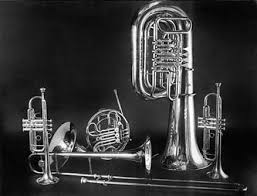
June is the sixth month in the Gregorian calendar, which is the calendar most in use throughout the world. This June, the Daily Classical Music Post will explore chamber music, choral music, and operatic sextets from the Renaissance to the 21st century.
The American composer Philip Glass (born 1937) is mainly associated with minimalism, but you wouldn’t know that from this early work, Brass Sextet (1964). This three-movement piece, lasting just under eight minutes, is a mostly consonant and straightforward work, nothing like his later and more famous compositions.
The first movement, called “Hymn,” is slow and majestic. The second movement, “Ballad,” is sombre and more dissonant than the first movement. “Finale” shows the influence of jazz music with its gentle syncopations. There are similarities throughout Brass Sextet to the compositions of American neoclassical composers such as Roy Harris and Aaron Copland, particularly Copland’s Fanfare for the Common Man, and it is a much more conservative work than would be expected from Glass. Glass withdrew most of his pre-minimalist early works, and Brass Sextet is one of the few that he has not totally disavowed, although he does not list it in his official active catalogue.
Peter Dickinson wrote, “Brass Sextet, composed in 1962/64 for two trumpets, two horns, trombone and tuba, is something of a curiosity. It was written when Philip Glass, after graduating from the Juilliard School of Music, was composer-in-residence with the Pittsburgh Public Schools on a Ford Foundation project. This was several years before he began to become known for the repetitive minimalist techniques which launched him to fame.”
Brass Sextet is a fascinating glimpse into Glass’s formative compositional techniques that he developed before immersing himself in Buddhism, Indian classical music, and minimalism, which became his signature style.
My classical music post for today is Philip Glass: Brass Sextet.


Leave a Reply