

Chamber music, sometimes described as “the music of friends,” is generally used to refer to music composed for a small group of instruments or voices, with one performer to a part. The intimacy of chamber music makes it a perfect genre for compositions marking important events or for unusual combinations of instruments. This April, the Daily Classical Music Post will introduce you to some of these very special works.
Telemann: ‘Musique de table’ / ‘Tafelmusik’ Production II
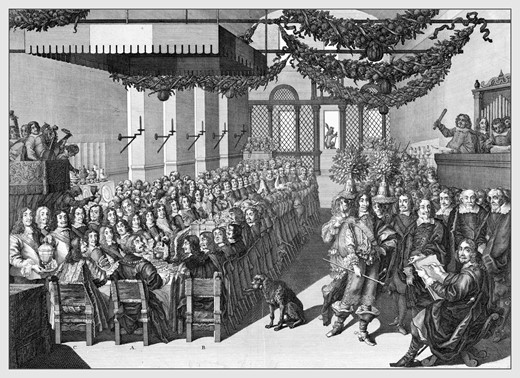
Georg Philipp Telemann (1681–1767) composed his Musique de table (also known as Tafelmusik) in 1733. This collection of instrumental compositions is one of the last examples of table music, which was music composed for and played at feasts and banquets. This type of music dates back to ancient times and was in favour until the late 18th century.
Musique de table is in three parts, called “Productions” (from the French). Each Production begins with an Ouverture for string orchestra and select wind or brass. This is followed by a quartet, a concerto with several soloists, a trio sonata, and a solo sonata. The final piece in each Production is called “Conclusion” and returns to the instrumentation of the Ouverture.
Steven D. Zohn said, “Telemann was certainly no stranger to the Tafelmusik tradition when he embarked on the Musique de table project. Many of the cantatas and serenatas he wrote for weddings, birthdays, and political events throughout his long career are likely to have been heard at banquets, though at present only a handful of these, in addition to a single instrumental work, can be confirmed as Tafelmusiken.” Musique de table was sold by subscription, at what at the time was a very expensive price, and it was extremely well received. Many of the purchasers were from the nobility or royalty, and famous musicians of the day also purchased the work.
Johan van Veen said, “The Tafelmusik collection is a good example of his art. . . . Telemann was a great admirer of the French style, and that explains the title of the collection. And the French goût is present everywhere in this set. . . . Telemann was open to the Italian style as well, and it is an indication of his originality that he was able to mix the various styles. He does so in an often unexpected way. It has been argued that in the concertos and the trios the three productions have a specific character: the first French, the second Italian and the third reminiscent of Dresden as a representative of the German style. There is certainly something in that. But at the same time Telemann mixes the three styles in every production.”
My classical music post for today is Georg Philipp Telemann’s Musique de table: Production II.


Leave a Reply