

June is the sixth month in the Gregorian calendar, which is the calendar most in use throughout the world. This June, the Daily Classical Music Post will explore chamber music, choral music, and operatic sextets from the Renaissance to the 21st century.
The American composer Emma Lou Diemer (1927–2024) wrote in many styles, ranging from tonal to atonal and from traditional to experimental. Many of her compositions were intended for performance by non-professional musicians, but other pieces, particularly her keyboard music, are extremely challenging and difficult to play. She said in an interview, “I always thought that one should write for all stages of development. There’s a lot of music that the beginner performer has to play that’s not very good. In other words, it’s not quality music. Whatever I write, I try to make a quality so far as I am capable. I don’t ever condescend or write down to the performer.”
She said in the same interview, “I’m very much a composer who likes to build on tradition and add to it, but with contemporary ideas. The music of the past that I think is great—like Bach and Brahms and some of Schumann and some of the others, and coming up to Prokofiev and some of Stravinsky and some of the very more contemporary composers—usually have to do first of all with the quality of the ideas that they are putting into the music. This includes the themes and the harmonies they’re using, the way they develop those ideas within a structure, the contrast they use, and the ability they have not to bore somebody. Music which is completely predictable or which doesn’t seem to be original as it proceeds, isn’t music that’s going to interest me for very long.”
Diemer composed two works titled Sextet: one for woodwind quintet and piano, in 1962, and the other, for flute, oboe, clarinet, violin, cello, and piano, in 1992. Bernard Holland reviewed the premiere of the 1992 Sextet: “Emma Lou Diemer’s Sextet offered a broad paraphrase of Stravinsky’s so-called Neo-Classical style: sharp colors, off-center meter, busy movement, a fugue at the end.”
Sextet (1992) is a fascinating work: sometimes melodic, sometimes really quite jarring, with plenty of movement to keep the listener interested. Each instrument has solo moments as well as interplay with the other instruments. From the almost eerie opening through to the exciting finish, this is a work that shows a composer who was adept at writing for a diverse ensemble while making it all sound unified.
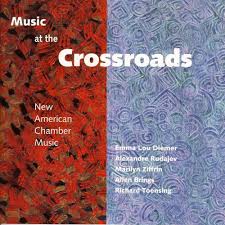
My classical music post for today is Emma Lou Diemer: Sextet (1992).


Leave a Reply