

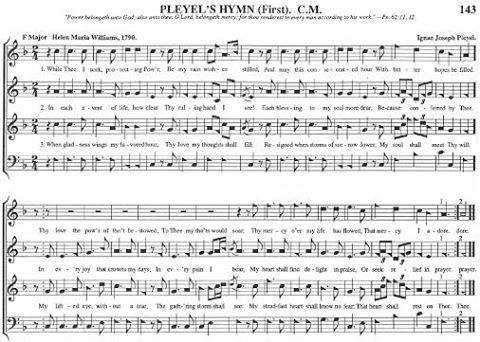
The medieval music theorist Guido d’Arezzo developed the four-line music staff—the precursor to the five-line staff—in or around the year 1024. Western art music notation as we know it today would not exist were it not for this revolutionary change. This February, the Daily Classical Music Post will explore music using interesting, unusual, and innovative music notation.
Sacred Harp 143 Pleyel’s Hymn HD
The American composer Benjamin Franklin White (1800–1879) was a shape note “singing master” and compiler of The Sacred Harp (1844), a shape note tunebook.
Shape note notation was developed as a way to help congregations and communities sing together. It was introduced in the United States in 1801 and became very popular in American singing schools. Shape note singing is described as “ . . . a fluent triple mental association, which links a note of the scale, a shape, and a syllable. This association can be used to help in reading the music. When a song is first sung by a shape note group, they normally sing the syllables (reading them from the shapes) to solidify their command over the notes. Next, they sing the same notes to the words of the music.”
Shape note notation, particularly the four shape system, was based on Guido’s solfege system. This system was in common use in 17th-century England. The English composer Thomas Morley described a four syllable system in his Plain and Easie Introduction to Practicall Musicke (published in 1597), and some people (most likely mistakenly) give Morley the credit for the four note system.
Sacred Harp singers first read the names of the notes from their shapes and then they sing the words of the song. This is a tradition that dates from the 17th century. Although Sacred Harp singing is not strictly “classical,” some of the conventions (for example, singing in a square, all four parts facing each other) are very similar to those of 17th-century part-songs, glees, and catches. In addition, the 1991 edition of The Sacred Harp includes some songs by classical composers, including Ignaz Pleyel.
My classical music post for today is The Sacred Harp: “Pleyel’s Hymn (First).”


Leave a Reply