

The medieval music theorist Guido d’Arezzo developed the four-line music staff—the precursor to the five-line staff—in or around the year 1024. Western art music notation as we know it today would not exist were it not for this revolutionary change. This February, the Daily Classical Music Post will explore music using interesting, unusual, and innovative music notation.
Nicola Vicentino: Musica prisca caput
The Italian music theorist and composer Nicola Vicentino (1511–1575 or 1576) composed what is considered to be the first microtonal work, “Musica prisca caput,” in his L’antica musica ridotta alla moderna prattica (Ancient Music Adapted to Modern Practice, 1555). Vicentino had always been interested in the enharmonic genera (in addition to the more usual diatonic and chromatic ones), and he decided to design an instrument, the archicembalo, which would incorporate 31 notes to the octave. (There is one surviving instrument built to Vicentino’s specifications; it can be seen in a museum in Bologna.)
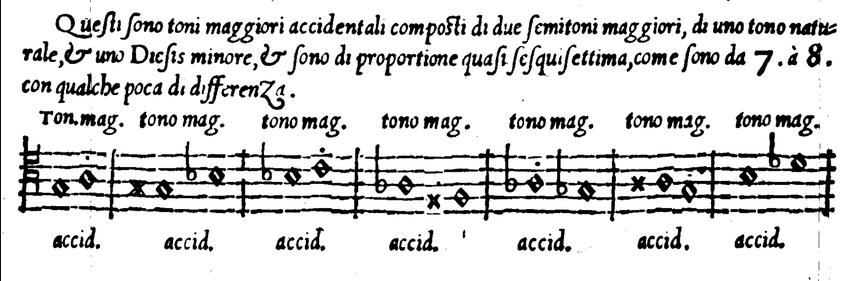
“Musica prisca caput” is the only complete extant work by Vicentino (there are a few other compositions surviving in short fragments only). This madrigal has been described as “polyphonically animated homophony.” Bill Alves said, “Vicentino defines the genera with the traditional tetrachords: the diatonic consisting of some combination of two whole tones and a semitone; the chromatic with two semitones, one major and one minor, and a minor third; and the enharmonic with two dieses (intervals smaller than a semitone) and a major third. Like the chromatic semitone, the enharmonic diesis may be either major, which would be the same size as the minor semitone, or minor, which would be one-half of that interval. Vicentino used a dot above the note to indicate that it was raised by a diesis. The way these three intervals are arranged within a perfect fourth defines the ‘species of the fourth,’ and four intervals may be analogously arranged within a perfect fifth to derive the ‘species of the fifth.’ When conjunctly joined, species of the fourth and fifth form the octave species, which include the traditional church modes.”
“Musica prisca caput” begins like pretty much any 16th-century keyboard work; it takes a little while before things start sounding a bit odd, even to the 21st-century ear. It’s a good 25 bars or so before things sound like they are going off the rails. Somehow, though, it seems to work.
My classical music post for today is Nicola Vicentino’s “Musica prisca caput.”


Leave a Reply