

The medieval music theorist Guido d’Arezzo developed the four-line music staff—the precursor to the five-line staff—in or around the year 1024. Western art music notation as we know it today would not exist were it not for this revolutionary change. This February, the Daily Classical Music Post will explore music using interesting, unusual, and innovative music notation.
George Crumb, “Black Angels,” Movt. 2, “Absence”
The American avant-garde composer George Crumb (1929–2022) did not intend his Black Angels to be a work about war, but it took him over a year to compose this work for electric string quartet, and by the time he was finished, in 1970, he decided it had some connection to the war in Vietnam. Black Angels is subtitled “Thirteen Images from the Dark Land,” and the date inscription on the score is “Friday the Thirteenth, March 1970 (in tempore belli)” (in time of war). According to an interview with Crumb, “As he acknowledges, the work ‘will probably be forever known as the Vietnam Quartet. I didn’t approach it that way. It was very late in the compositional process that I became aware of associations with that period. Some have suggested that even some of the titles refer to the geography of Vietnam, such as “Night of the Electric Insects.”’ ‘Black Angels,’ a 20-minute work in 13 sections, took Crumb almost a year to complete. ‘I came to recognize that there was something of the feeling of that strange time. That’s when I called it music in tempore belli, in time of war.’”
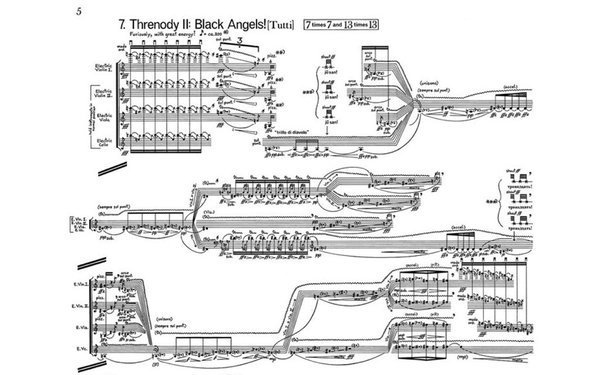
Black Angels is in three main parts. The second part, Absence, begins with a Pavana Lachrymae, which moves seamlessly into the second of three Threnodies (this one is called Threnody II: Black Angels!), then into the Sarabanda de la Muerte Oscura, and finally Lost Bells (Echo). The numbers 7 and 13 figure prominently in the entire work, also Crumb has said that the whole “numbers thing” should be played down: he once said that he kind of “got carried away with the Friday the 13th thing.”
Although the main instruments played are the standard string quartet (two violins, viola, and cello), the musicians also play specially prepared electric string instruments, crystal glasses, thimbles, paper clips, maracas, and other percussion instruments, and they even speak occasionally. As many people have noted, Crumb’s scores are a form of visual art as well, as you can see in the first page of Threnody II: Black Angels!
My classical music post for today is George Crumb’s Black Angels, II. Absence.


Leave a Reply