

Throughout human history, technological developments have transformed the ways we live, work, communicate, and create. This November, the Daily Classical Music Post will explore compositions inspired by or made possible through many of these innovations and inventions, discovering how the changing world has shaped the music we make and hear.
Prokofiev: Le pas d’acier (The Steel Step or The Leap of Steel), Op. 41
In the 1920s, the Russian composer Sergei Prokofiev (1891–1953) was living in the West, having left Russia in 1918 following the Bolshevik Revolution. His career took him to the United States and eventually Paris, where the celebrated impresario Sergei Diaghilev commissioned him to write for his Ballets Russes. But rather than another work inspired by Russian folklore or fairy tales, Diaghilev wanted something distinctly modern: a ballet about life in the new Soviet Union. The result was Le Pas d’acier (The Steel Step), composed in 1925–1926 and first performed in 1927.
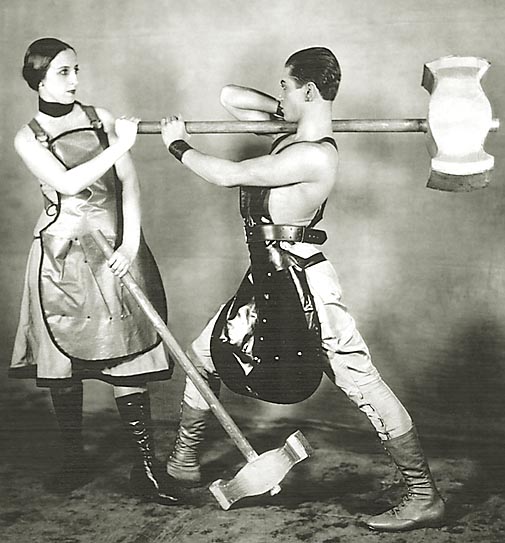
The ballet was developed in collaboration with the Russian artist Georgy Yakulov, who designed the scenery and costumes and helped create the scenario. Yakulov was associated with the experimental artistic movements flourishing in the Soviet Union, particularly Constructivism, which embraced industrial materials, geometric forms, and the visual language of modern machinery. The ballet’s two scenes depict the transformation of Soviet society. The first takes place amid the disorder of a railway station and marketplace, while the second moves into a vast factory, where workers operate machinery and industrial production becomes the focus of the action. Even the romantic relationship between a sailor and a young working woman becomes part of this vision of collective labour.
Prokofiev’s music reflects the mechanical energy of the setting. Driving rhythms, repeated musical patterns, dissonant harmonies, and powerful orchestral effects evoke the movement of gears, the pounding of hammers, and the relentless activity of a factory. The ballet culminates in a sequence of industrial dances, with the orchestra creating the impression of machinery operating at full capacity. There are obvious connections with Alexander Mosolov’s Iron Foundry and Arthur Honegger’s Pacific 231. Prokofiev had been impressed by Honegger’s depiction of a steam locomotive, and all three works belong to a period when composers were exploring the musical possibilities of the machine age.
Le Pas d’acier premiered on 7 June 1927 at the Théâtre Sarah-Bernhardt in Paris, with choreography by Léonide Massine. Its reception was fascinatingly divided. Some critics regarded the ballet as a celebration of Soviet industrial progress, while others wondered whether its portrayal of workers and machinery was intended as satire. The political circumstances added another dimension: Britain and the Soviet Union had broken diplomatic relations only weeks before the ballet’s London performances. Yet the production proved successful enough to remain in the Ballets Russes repertoire until Diaghilev’s death in 1929.
There’s a particularly interesting contradiction in all this. Prokofiev and Diaghilev were both living outside the Soviet Union, yet they were presenting Western audiences with an artistic vision of Soviet modernity. And although the ballet appeared to celebrate the achievements of the new socialist society, its creators were working within the sophisticated, commercially supported world of the Parisian avant-garde. The music, scenery, choreography, and politics were all part of the same extraordinary artistic experiment.
My classical music post for today is Sergei Prokofiev: Le Pas d’acier, Op. 41.


Leave a Reply