

Throughout human history, technological developments have transformed the ways we live, work, communicate, and create. This November, the Daily Classical Music Post will explore compositions inspired by or made possible through many of these innovations and inventions, discovering how the changing world has shaped the music we make and hear.
Johanna M. Beyer – Music Of The Spheres [1938]
The German-born American composer Johanna Beyer (1888–1944) was one of the most adventurous musical experimenters of the 1930s, although her work remained largely unknown for decades after her death. Born in Leipzig, she emigrated to the United States in 1923 and eventually settled in New York, where she became involved with a remarkable circle of composers exploring new approaches to rhythm, harmony, and musical structure. Among them were Henry Cowell, Charles Seeger, and Ruth Crawford Seeger, leading figures in the American ultramodernist movement. Beyer studied with Cowell and became a close associate, helping him with his musical activities and supporting him during his imprisonment. Yet despite her own originality, she struggled to gain recognition in a musical world that offered women composers relatively few opportunities.
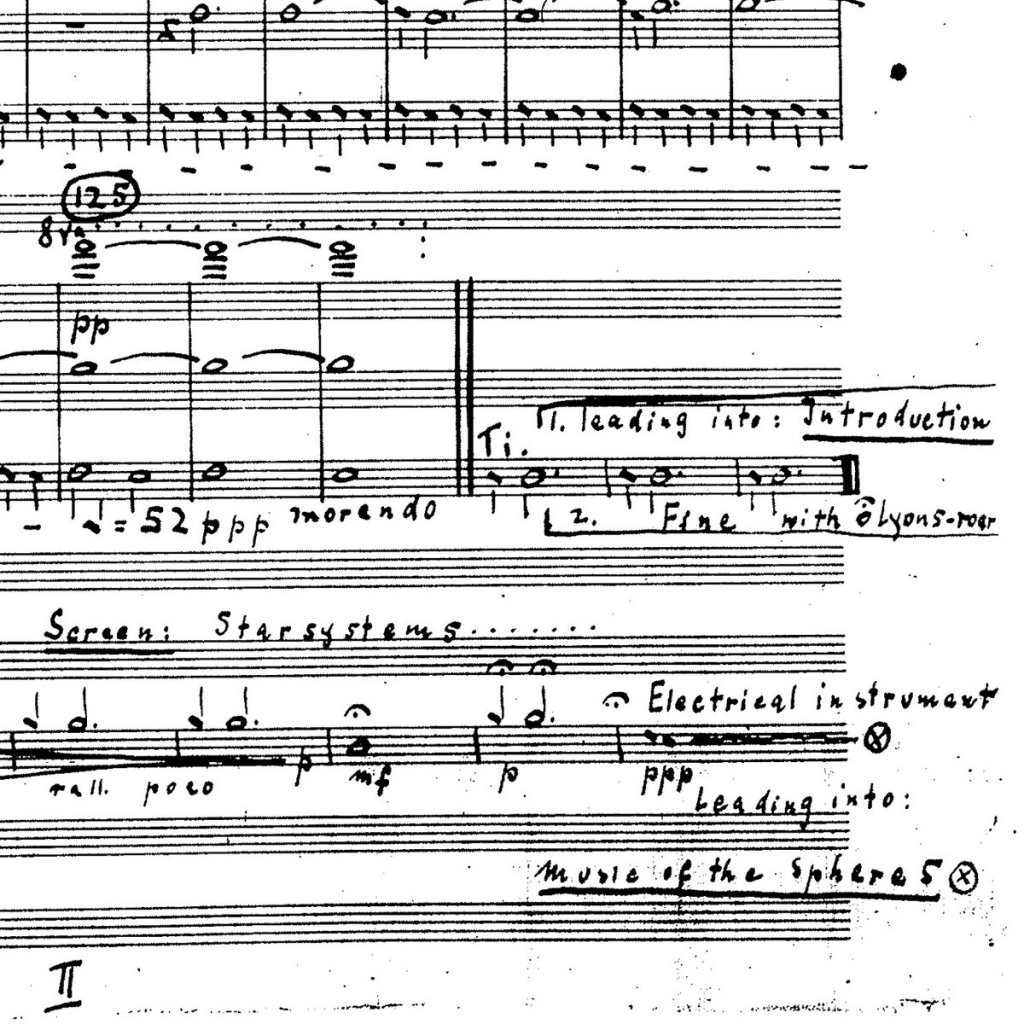
In 1938, Beyer composed Music of the Spheres, one of the earliest known works written by a woman for electronic instruments. The score specifies three unspecified electrical instruments, with strings offered as an alternative, together with percussion. Exactly which electronic instruments Beyer had in mind remains uncertain, although she was familiar with the theremin, an instrument played without physical contact by moving the hands near two antennas. Her music makes extensive use of glissandi, notes that slide continuously from one pitch to another, creating sounds that conventional orchestral instruments cannot always reproduce with the same smoothness.
But Music of the Spheres was never intended to stand entirely alone. Beyer conceived it as part of an ambitious four-act musical theatre project called Status Quo, which would combine music, drama, dance, narration, and projected images. The work was to explore humanity’s development and the contradictions of modern civilisation, with a distinctly political perspective. In 1938, as Europe moved towards another devastating war and the United States continued to struggle with the consequences of the Great Depression, Beyer was deeply concerned about social injustice and the direction of the modern world. She applied for a Guggenheim Fellowship to support the project, but her application was rejected, and Status Quo was never completed.
The music itself is extraordinary. Three slowly moving lines slide between pitches, gradually accelerating towards the middle of the composition before slowing again. The effect is mysterious, almost otherworldly, as though we are listening to sounds travelling across immense distances. Beyer’s conception reflects the ancient philosophical idea of the music of the spheres, in which the movements of celestial bodies were believed to correspond to mathematical harmonies. But she imagines those harmonies through the possibilities of modern electronic sound, bringing together an ancient concept and a technology that was still in its infancy.
Beyer never heard the work performed electronically. It was not until 1977, more than three decades after her death, that the Electric Weasel Ensemble recorded Music of the Spheres using electronic instruments. The recording appeared on the groundbreaking album New Music for Electronic and Recorded Media: Women in Electronic Music, helping to bring attention to a composer whose achievements had been almost entirely forgotten. Beyer died in 1944, leaving behind a remarkable body of music that has only gradually received the recognition it deserves.
My classical music post for today is Johanna Beyer: Music of the Spheres.


Leave a Reply