

Throughout human history, technological developments have transformed the ways we live, work, communicate, and create. This November, the Daily Classical Music Post will explore compositions inspired by or made possible through many of these innovations and inventions, discovering how the changing world has shaped the music we make and hear.
Lejaren Hiller – Illiac Suite for String Quartet [1/4]
In 1956, at the University of Illinois, something extraordinary happened. A computer began composing music: not merely playing music that someone had written, but actually generating musical material according to a set of mathematical instructions. The result was the ILLIAC Suite, a work for string quartet created by the American composer and chemist Lejaren Hiller (1924–1994) in collaboration with Leonard Isaacson (1925–2015). It is widely recognised as one of the earliest substantial musical compositions produced with the assistance of a digital computer, and it marked the beginning of an entirely new chapter in the relationship between music and technology.
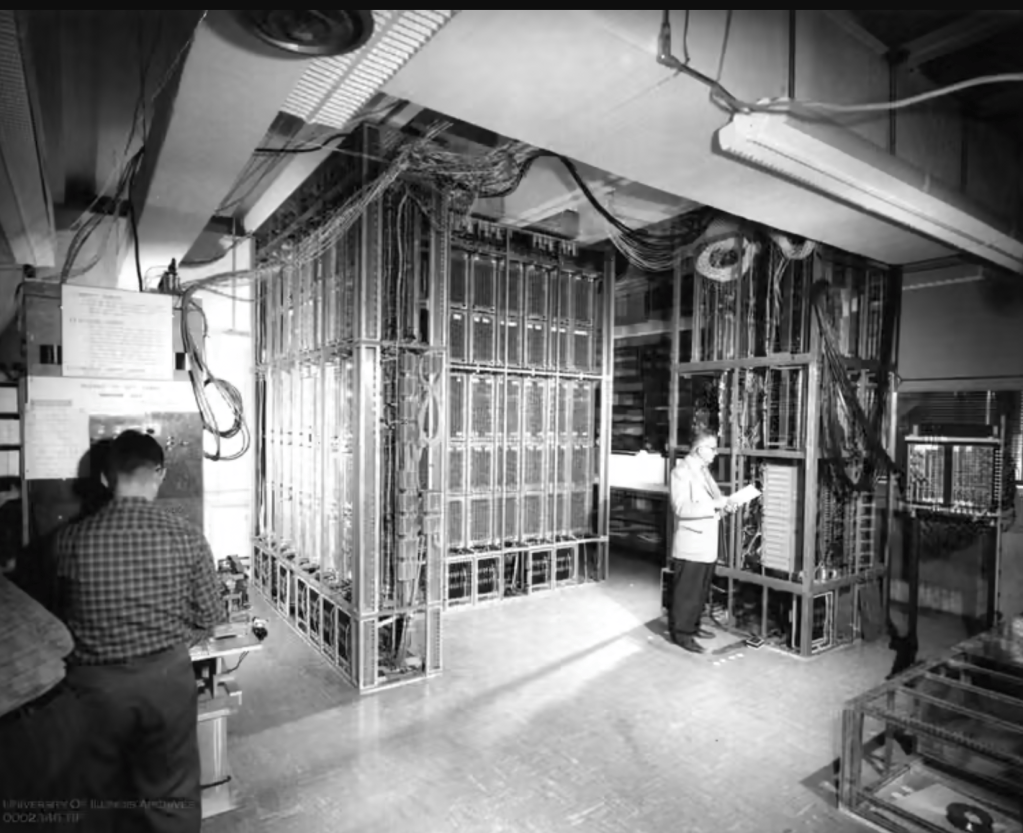
Hiller had an unusual background for a composer. He studied chemistry at Princeton University and joined the University of Illinois chemistry faculty in 1952, while continuing his musical studies. Isaacson was a fellow scientist with expertise in computer programming. The university had recently developed the ILLIAC I, one of the first computers built and owned by an American university. It was an enormous machine, weighing approximately five tons, and its capabilities were extraordinarily limited by today’s standards. Nevertheless, Hiller recognised that some of the mathematical procedures used in scientific research might also be applied to the rules governing musical composition. With Isaacson’s programming assistance, he began experimenting.
The two men devised a series of four experiments, each exploring a different aspect of musical composition. In the first, they instructed the computer to generate simple melodies according to established musical rules. The second explored four-part counterpoint, using principles derived from Renaissance polyphony. The third introduced more complex rhythms, dynamics, and chromatic harmonies, while the fourth used mathematical probabilities to determine how musical patterns developed. The computer generated far more material than could be included in a single composition, so the researchers selected representative examples and arranged them into four movements for string quartet.
What makes this particularly fascinating is that the computer wasn’t producing electronic sounds. The finished music was written out as a conventional score and performed by four human string players. The technology was involved in the process of composition, rather than performance. On 9 August 1956, a student quartet performed the first three movements at the University of Illinois. The completed suite was published in 1957, and Hiller and Isaacson subsequently documented their research in a book entitled Experimental Music: Composition with an Electronic Computer (1959).
The music itself offers a fascinating journey. The opening experiment can sound surprisingly traditional, with clear melodic lines and recognisable contrapuntal patterns. As the experiments progress, the music becomes increasingly unpredictable, sometimes resembling the more adventurous compositions of the 20th century. But perhaps the most remarkable aspect is that the researchers were not primarily attempting to create a masterpiece. They were investigating whether a computer could follow musical rules, generate new material, and participate in the creative process.
Nearly 70 years later, as artificial intelligence raises questions about authorship, originality, and the future of artistic creativity, the ILLIAC Suite seems remarkably prophetic. Hiller and Isaacson were already confronting questions that remain unresolved today. Can a machine compose? Where does the creativity reside: in the instructions, the resulting music, or the human imagination that brought the two together?
My classical music post for today is Lejaren Hiller and Leonard Isaacson: ILLIAC Suite, Experiment 1.


Leave a Reply