

Throughout human history, technological developments have transformed the ways we live, work, communicate, and create. This November, the Daily Classical Music Post will explore compositions inspired by or made possible through many of these innovations and inventions, discovering how the changing world has shaped the music we make and hear.
Mozart ‐ Fantasia for Mechanical Organ in F minor, K 608
The Austrian composer Wolfgang Amadeus Mozart (1756–1791) was no stranger to unusual commissions, but in the final year of his life he found himself writing music for a mechanical instrument that he didn’t particularly like. His Fantasia in F minor, K. 608, was composed in Vienna on 3 March 1791 for a clockwork organ, an invention that could play music automatically without anyone sitting at a keyboard. It was one of three pieces Mozart wrote for such instruments, and it was by far the most substantial.
The commission came from Count Joseph Deym, an aristocrat who operated a popular art gallery and waxworks museum in Vienna under the name Müller (Deym had once been forced to flee Austria after killing an opponent in a duel, and subsequently returned under an assumed name). His collection included sculptures, wax figures, mechanical curiosities, and an elaborate memorial to the recently deceased Austrian military commander Field Marshal Ernst Gideon von Laudon. Visitors could admire a wax figure of the famous general lying in a glass coffin while a mechanical organ supplied solemn music. The attraction was advertised as offering a different piece of funeral music each week, and Mozart was among the composers whose work could be heard there.
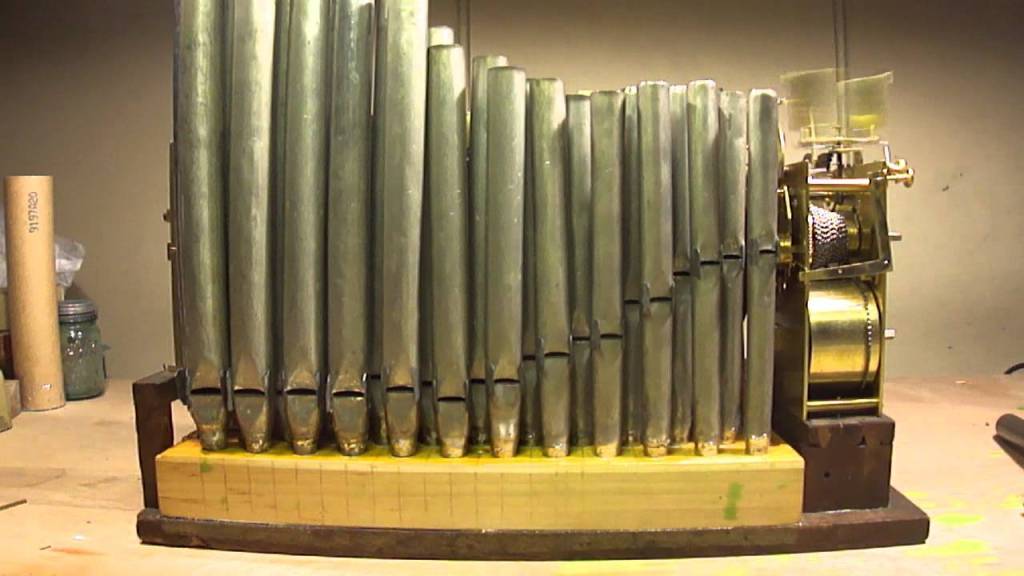
Like the mechanical clocks for which Joseph Haydn composed, the instrument used a rotating cylinder fitted with pins to operate a small organ. The positions of the pins determined which notes were played and when, allowing the machine to reproduce an entire composition without a human performer. It was an ingenious invention, but Mozart was distinctly unimpressed by its musical possibilities. In a letter to his wife Constanze in October 1790, he complained that he found composing for the instrument tedious and disliked its tiny, high-pitched pipes. He admitted that he was persevering largely because he needed the money. If only the instrument had been a proper, full-sized organ, he suggested, he might have enjoyed the work considerably more! (Mozart was never shy about complaining about his commissions, and this one was no exception.)
Despite his misgivings, the Fantasia in F minor is an extraordinarily ambitious composition. It opens with a dramatic Allegro, followed by an elaborate fugue in which musical lines enter successively and intertwine. A gentler Andante provides a lyrical contrast before the opening material returns, leading to another impressive display of counterpoint. The music has a grandeur and complexity that seem almost at odds with the little mechanical instrument for which it was intended. It is hardly surprising that the work soon attracted the attention of musicians who wanted to perform it on conventional organs and other keyboard instruments.
I think that there is something extremely amusing about the fact that Mozart, who had spent his childhood astonishing European audiences with his abilities at the keyboard, was now being paid to write music for an instrument that required no performer at all. Yet the mechanical organ could only reproduce what had been programmed into it. The extraordinary musical imagination behind those notes was entirely Mozart’s, and more than two centuries later the Fantasia remains one of the most impressive works ever written for a musical machine.
My classical music post for today is Wolfgang Amadeus Mozart: Fantasia in F minor for Mechanical Organ, K. 608.


Leave a Reply