

Throughout human history, technological developments have transformed the ways we live, work, communicate, and create. This November, the Daily Classical Music Post will explore compositions inspired by or made possible through many of these innovations and inventions, discovering how the changing world has shaped the music we make and hear.
Pacific 231: Mouvement Symphoique
The Swiss-French composer Arthur Honegger (1892–1955) was born in Le Havre, France, to Swiss parents, and spent most of his professional life in Paris. He was a member of Les Six, the group of young composers that also included Francis Poulenc, Darius Milhaud, and Germaine Tailleferre. Unlike some of his colleagues, Honegger retained a particular admiration for the music of Johann Sebastian Bach and Ludwig van Beethoven, combining traditional musical structures with the energetic rhythms and sounds of the modern world.
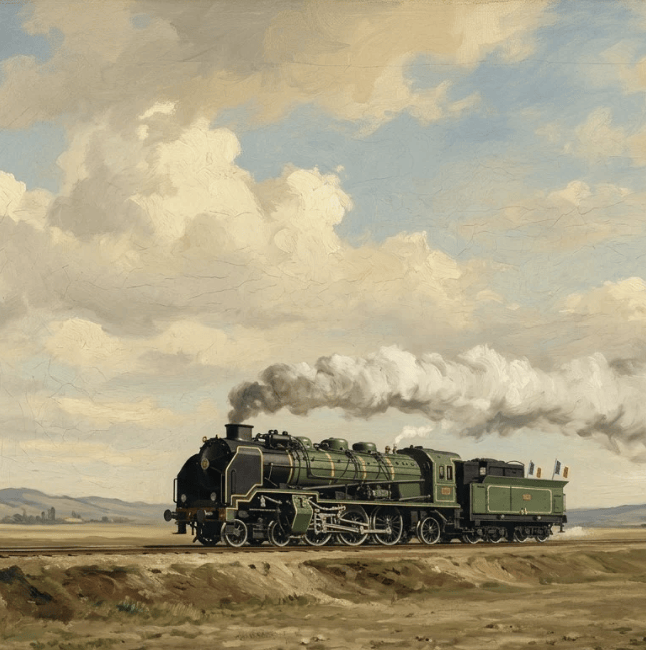
Honegger was also an enthusiastic railway lover. He once declared, “I have always loved locomotives passionately. For me they are living creatures and I love them as others love women or horses.” In the early 20th century, steam locomotives were among the most impressive examples of modern engineering, capable of transporting enormous loads at speeds that would have seemed unimaginable a century earlier. The Pacific locomotive, with its powerful driving wheels and distinctive arrangement of axles, became particularly associated with fast passenger trains. The numbers 2-3-1 refer to the French system of classifying locomotives by their axles: two leading axles, three driving axles, and one trailing axle.
In 1923, Honegger composed a short orchestral work that he initially called Mouvement symphonique. He subsequently renamed it Pacific 231, and it received its premiere in Paris on 8 May 1924, conducted by Serge Koussevitzky. The music begins slowly, with heavy, sustained sounds suggesting a locomotive standing at rest. Gradually, the orchestra begins to move, its rhythms becoming increasingly insistent as the enormous machine seems to gather momentum. Repeated figures in the strings and winds, powerful brass, and driving percussion create the impression of wheels turning, pistons working, and a train accelerating along the tracks.
But Honegger later insisted that his composition was not simply an attempt to imitate the sounds of a locomotive. His real interest was in creating the sensation of acceleration through musical rhythm, even while the underlying musical movement was actually slowing down. He described it as an abstract mathematical idea, and even compared its contrapuntal structure to the music of Johann Sebastian Bach. He was amused by critics who wrote elaborate descriptions of his imaginary train journey, remarking that it would be unkind to spoil their enjoyment by explaining what he had really intended.
The piece became one of Honegger’s most popular compositions and an enduring musical symbol of the machine age. In 1949, the French filmmaker Jean Mitry created an experimental short film, also called Pacific 231, combining Honegger’s music with dramatic images of a steam locomotive, its wheels, pistons, and machinery. The film won an award at the Cannes Film Festival, demonstrating how effectively music, cinema, and modern technology could work together. Whether we hear a train racing through the countryside or an ingenious experiment in musical rhythm, Pacific 231 captures something of the excitement and fascination that machinery inspired in the early 20th century.
My classical music post for today is Arthur Honegger: Pacific 231.


Leave a Reply