

Throughout human history, technological developments have transformed the ways we live, work, communicate, and create. This November, the Daily Classical Music Post will explore compositions inspired by or made possible through many of these innovations and inventions, discovering how the changing world has shaped the music we make and hear.
The British composer and electronic music pioneer Daphne Oram (1925–2003) was born in Devizes, Wiltshire. As a young woman, she was offered a place at the Royal College of Music but instead chose to work for the BBC, joining as a junior sound engineer during World War II. She became fascinated by the possibilities of electronic sound and began experimenting with tape recorders, oscillators, and other equipment, often working late into the night after her regular duties had finished. In 1958, after years of campaigning for a dedicated electronic music facility, she co-founded the BBC Radiophonic Workshop with Desmond Briscoe.
The Radiophonic Workshop would eventually become famous for creating the electronic sounds and music associated with programmes such as Doctor Who, but Oram’s ambitions went considerably further than producing sound effects for radio and television. Frustrated by the BBC’s reluctance to support her experimental work, she resigned in 1959 and established her own electronic music studio in a converted oast house in Kent. There she began developing an extraordinary invention that she called Oramics, a system that would allow composers to create electronic music by drawing it.
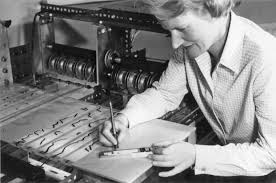
The idea had come to her years earlier while studying an oscilloscope, an instrument that displays sound waves as patterns on a screen. Oram wondered whether the process could be reversed: instead of turning sound into a picture, could a picture be turned into sound? Her eventual invention used strips of 35mm film on which she drew lines, shapes, and patterns. As the film passed through the machine, photoelectric cells detected the markings and translated them into electrical signals controlling the pitch, volume, and character of electronically generated sounds. A composer could literally draw the sounds they wanted to hear.
In 1962, Oram received a grant from the Calouste Gulbenkian Foundation to develop the machine, and the following year she recorded Contrasts Essonic, the first composition created entirely through her drawn-sound system. The piece explores the unusual sounds that Oramics could produce, with changing electronic tones, contrasting textures, and patterns that would have been difficult to achieve using conventional musical instruments. Rather than writing notes for performers to interpret, Oram was creating and shaping the sounds themselves, working directly with the physical properties of sound.
Oram continued experimenting with electronic music for the rest of her career, although her inventions never achieved widespread commercial success. Her original Oramics machine is now preserved in London’s Science Museum, a recognition of its importance in the history of electronic music. The technology anticipated aspects of modern computer-based composition, including the ability to manipulate sound visually on a screen. More than 60 years after Contrasts Essonic was recorded, musicians routinely use software to shape sounds in ways that Oram could only begin to imagine with her remarkable machine.
My classical music post for today is Daphne Oram: Contrasts Essonic.


Leave a Reply