

Throughout human history, technological developments have transformed the ways we live, work, communicate, and create. This November, the Daily Classical Music Post will explore compositions inspired by or made possible through many of these innovations and inventions, discovering how the changing world has shaped the music we make and hear.
The British composer and sound artist Vicky Clarke, who works under the name SONAMB, is based in Manchester, a city whose history is inseparable from the Industrial Revolution. During the 18th and 19th centuries, Manchester became one of the world’s great centres of cotton manufacturing, with enormous mills, canals, and factories transforming both the landscape and the lives of the people who worked there. Clarke’s work explores the relationships among sound, technology, and the physical environment, often incorporating field recordings, electronics, and experimental approaches to composition.
NEURAL MATERIALS (2024) was developed through a two-year research commission from Cyborg Soloists, a project at Royal Holloway, University of London. It received its first performance at Modern Art Oxford in April 2024, with visuals created by digital artist Sean Clarke. Clarke describes the work as a love letter to the materials of a post-industrial city, bringing together Manchester’s industrial past and its technologically-driven present.
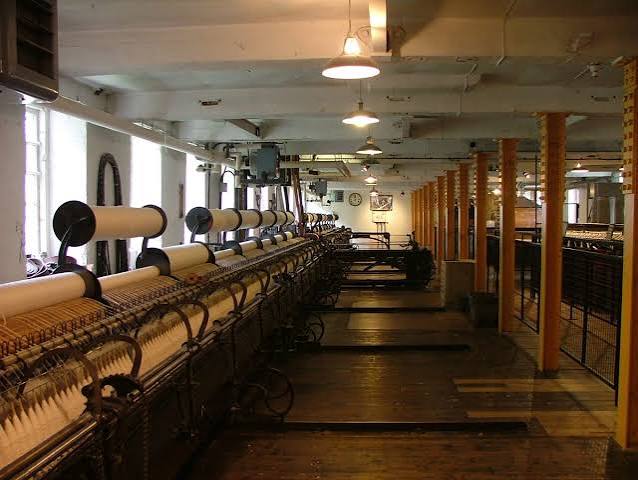
To create the piece, Clarke visited Quarry Bank Mill in Cheshire, built in 1784 and now preserved by the National Trust. There she recorded the sounds of historic textile machinery, including carding machines, spinning frames, and Lancashire looms. She also recorded water from Manchester’s canal network and the sounds of the modern city. These recordings became a collection of sounds used to train a machine-learning model called PRiSM SampleRNN, which generated new musical material based on the rhythms and textures of the original recordings. Rather than simply reproducing the machines’ sounds, the system created unexpected combinations and patterns that Clarke could incorporate into her composition.
The performance itself combines these AI-generated sounds with modular synthesizers, electronics, and a specially designed metal sound sculpture fitted with touch-sensitive controls. By touching and moving her hands across the sculpture, Clarke can manipulate the sounds in real time, making each performance partly improvised. The result brings together the repetitive mechanical rhythms of the 19th-century cotton mill and the possibilities of 21st-century AI. There is something particularly fascinating about the idea that machines that once transformed the way people worked can now, more than two centuries later, contribute to the creation of entirely new music.
My classical music post for today is Vicky Clarke: NEURAL MATERIALS.


Leave a Reply