

Throughout human history, technological developments have transformed the ways we live, work, communicate, and create. This November, the Daily Classical Music Post will explore compositions inspired by or made possible through many of these innovations and inventions, discovering how the changing world has shaped the music we make and hear.
Schubert: Gretchen am Spinnrade, D. 118
The Austrian composer Franz Schubert (1797–1828) was only 17 years old when, on 19 October 1814, he composed Gretchen am Spinnrade (Gretchen at the Spinning Wheel), a song that would become one of the landmarks of the German Lied, or art song. Although Schubert had already written a considerable amount of music, this was his first setting of a text by Johann Wolfgang von Goethe, whose poetry would inspire many more of his compositions. Schubert eventually wrote more than 600 songs, transforming the relationship between poetry, voice, and piano in the process.
The text comes from Goethe’s Faust, Part One, published in 1808. Gretchen, a young woman who has fallen in love with Faust, sits at her spinning wheel, unable to concentrate on her work. Her thoughts are consumed by him, and she sings, “Meine Ruh’ ist hin, mein Herz ist schwer” (My peace is gone, my heart is heavy). As she remembers his appearance, his voice, and finally his kiss, her emotions become increasingly intense. The scene is especially poignant because the audience knows that her relationship with Faust will end tragically.
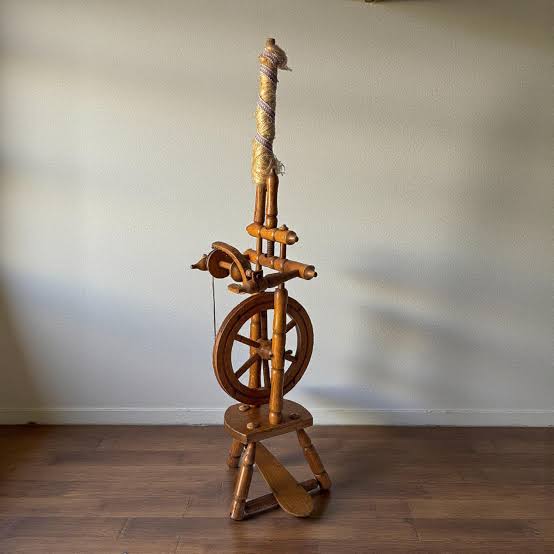
The spinning wheel itself is an important part of the story. For centuries, spinning was an essential household occupation, particularly for women, who transformed wool, flax, and other fibres into thread for weaving and making clothing. The spinning wheel, developed long before the Industrial Revolution, was a significant technological improvement over the earlier hand spindle, allowing thread to be produced more efficiently. By Goethe’s time, spinning was both a familiar domestic activity and a powerful literary symbol of women’s work and everyday life.
Schubert makes the spinning wheel almost another character in the song. The piano’s right hand plays a continuous pattern of rapidly turning notes, suggesting the wheel’s rotation, while the left hand provides a repeated rhythmic figure that evokes its mechanical movement. As Gretchen’s emotions intensify, the music grows increasingly agitated. When she recalls Faust’s kiss, the piano suddenly falls silent, as though she has become so overwhelmed that she has stopped spinning altogether. Gradually, the wheel begins turning again, but Gretchen’s troubled thoughts remain unchanged. It is a remarkable example of how a composer can use a simple musical figure to portray both a physical machine and a human state of mind.
My classical music post for today is Franz Schubert: Gretchen am Spinnrade, D. 118.


Leave a Reply