

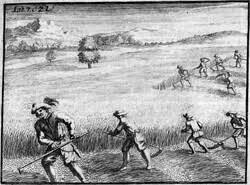
For millennia, the rhythms of planting and harvest have shaped human life, marking seasons of labour, renewal, abundance, and gratitude. This October, the Daily Classical Music Post will journey across eras and continents, celebrating harvest in the Northern Hemisphere and planting in the Southern through music inspired by the Earth and its changing seasons.
Johann Abraham Peter (more commonly known as J.A.P.) Schulz (1747–1800) was a German composer, conductor, and music theorist who studied with Johann Philipp Kirnberger, himself a pupil of Johann Sebastian Bach. Schulz worked in Berlin and later served as Kapellmeister to Prince Heinrich of Prussia and then at the Danish royal court in Copenhagen. He was particularly well-known for his collections of memorable songs intended to be easy and straightforward enough that people might sing them as though they had always known them.
“Wir pflügen und wir streuen” (We plough and we scatter) appeared in Schulz’s Lieder im Volkston in 1800, set to words by the poet Matthias Claudius. Claudius’s text had originally appeared in 1782 as part of a much longer work describing a harvest celebration. Schulz selected verses concerned with sowing, growth, and thanksgiving, and gave them the melody that is still associated with the hymn today.
The music is deliberately uncomplicated. Schulz believed that a successful Volkslied, or song in a popular style, should possess what he called the “appearance of the familiar.” Here the melody moves mostly in simple, singable phrases, with a regular pulse and clear harmonic structure. Each verse uses essentially the same music, allowing a congregation or community to join in easily. The tune rises naturally towards important phrases before settling firmly back into its home key, giving it the confident simplicity of a song designed to be remembered after a single hearing.
In the text, people plough and scatter the seed, but the rain and sunshine that make it grow are beyond their control. The Earth produces its fruit; the grain is gathered; and the response is gratitude for the harvest.
The song became especially familiar in the English-speaking world through Jane Montgomery Campbell’s 19th-century translation, “We Plough the Fields and Scatter,” which remains a traditional harvest hymn.
In “Wir pflügen und wir streue,” Schulz brings the whole process together with remarkable simplicity: we can prepare the earth, plant the seed, and gather the crop, but we cannot make it grow.
My classical music post for today is J.A.P. Schulz: “Wir pflügen und wir streue.”


Leave a Reply