

For millennia, the rhythms of planting and harvest have shaped human life, marking seasons of labour, renewal, abundance, and gratitude. This October, the Daily Classical Music Post will journey across eras and continents, celebrating harvest in the Northern Hemisphere and planting in the Southern through music inspired by the Earth and its changing seasons.
LIBBY LARSEN: Barn Dances for Flute, Clarinet and Piano (2001)
Libby Larsen (born 1950) is one of the most prominent contemporary American classical composers. In 1973 she co-founded the Minnesota Composers Forum, now the American Composers Forum, and her enormous catalogue ranges from opera and orchestral music to songs and chamber works. She has often drawn inspiration from the rhythms and sounds of U.S. life and speech.
Barn Dances was composed in 2001 for flute, clarinet, and piano. Larsen describes it as a set of four “abstract pieces” based on U.S. dance forms, each exploring what happens when the characteristic rhythm and energy of a traditional dance are transferred to this small chamber ensemble. The movements are titled “Forward Six and Fall Back Eight”; “Divide the Ring”; “Varsouvianna”; and “Rattlesnake Twist.”
The first two titles come from square-dance calls, and Larsen makes the instruments behave almost like dancers responding to instructions. Short rhythmic figures are tossed rapidly among flute, clarinet, and piano; phrases start, stop, and change direction, creating the impression of groups moving forwards, backwards, separating, and re-forming. The piano often supplies the strong rhythmic footing while the flute and the clarinet dart around above it, sometimes moving together and sometimes seeming to chase one another.
In “Varsouvianna,” the character changes completely. The varsovienne was a 19th-century couples dance that combined elements of the waltz, polka, and mazurka, so Larsen gives this movement a more graceful, swaying quality. Then “Rattlesnake Twist” brings back the physical energy, with quick repeated notes, syncopations, and sharply articulated gestures. Throughout the piece, Larsen doesn’t simply reproduce old dance tunes. Instead, she takes the rhythms of the dances and turns them into contemporary chamber music.
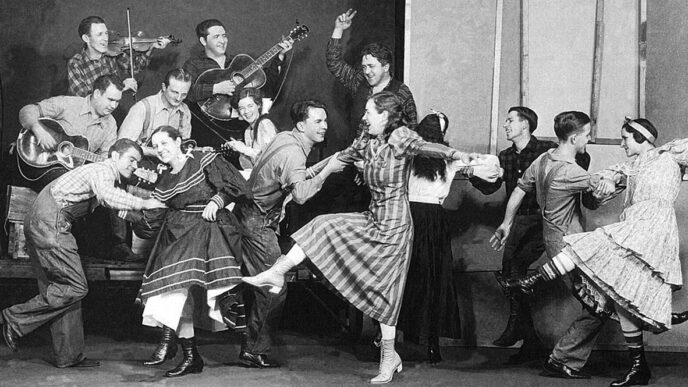
Barns were not only places where crops, hay, and animals were kept; in rural communities, they could also become gathering places, with dances providing music, sociability, and entertainment after the day’s work was finished. So today, nobody has to plant, reap, thresh, or grind anything. After everything the farmers have had to do this month, they’ve definitely earned a night of dancing.
My classical music post for today is Libby Larsen: Barn Dances.


Leave a Reply