

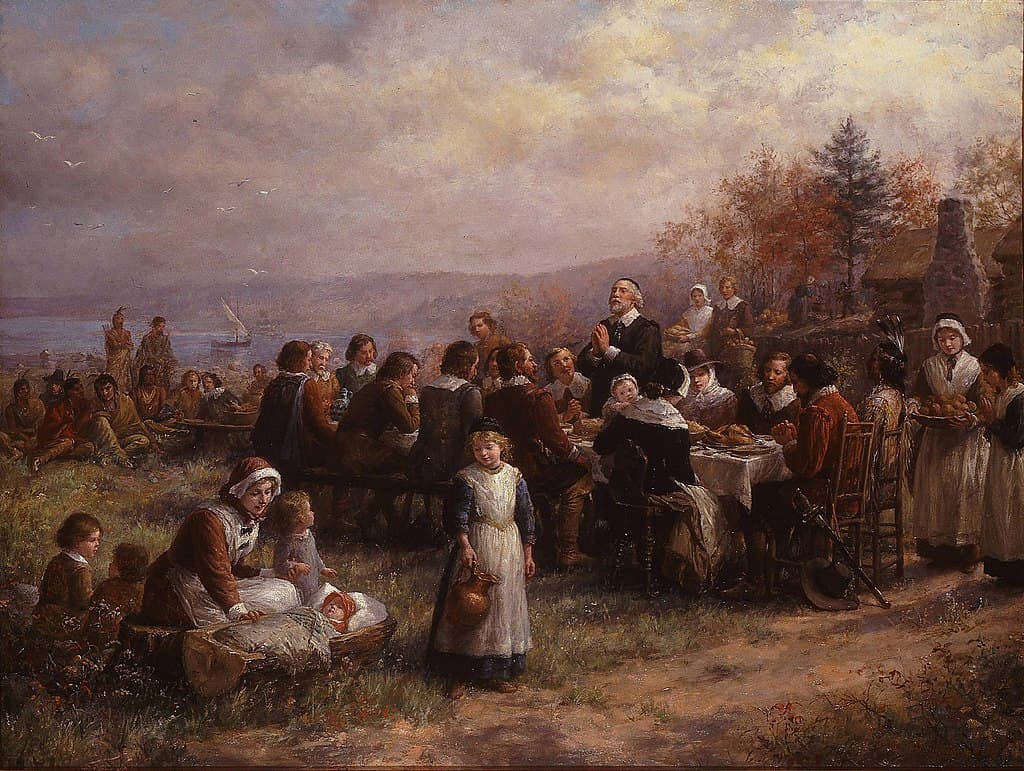
For millennia, the rhythms of planting and harvest have shaped human life, marking seasons of labour, renewal, abundance, and gratitude. This October, the Daily Classical Music Post will journey across eras and continents, celebrating harvest in the Northern Hemisphere and planting in the Southern through music inspired by the Earth and its changing seasons.
Holidays Symphony: IV. Thanksgiving and Forefathers’ Day
Charles Ives (1874–1954) was born in Danbury, Connecticut, and was one of the most original American composers of the early 20th century. His music was deeply influenced by the sounds of his New England childhood: church hymns, marching bands, patriotic songs, and community celebrations. He frequently composed works superimposing several of these sounds, reproducing something like the experience of hearing different bands, congregations, or groups of people arriving from different directions.
Thanksgiving and Forefathers’ Day eventually became the fourth and final movement—representing autumn—of A Symphony: New England Holidays, which Ives composed from 1897 to 1913. The origins of this work go back to music that Ives wrote for a Thanksgiving church service while working as an organist; he incorporated that material into Thanksgiving in 1904, which he continued to revise over the next decade.
The music begins solemnly and rather strangely. Ives deliberately places harmonies in different keys against one another, including C minor and D minor simultaneously, to suggest what he described as the “sternness and strength and austerity” of the Puritan character. Beneath this he describes (in the music) a scythe in what he called the “reaping theme,” which he deliberately set in awkward counterpoint and rhythm.
Gradually the landscape changes. Fragments of familiar American hymns emerge from the orchestral texture, including George Frederick Root’s The Shining Shore. Different tunes and tonalities overlap, as though several memories of old New England were being heard simultaneously. Finally, a chorus enters with the Thanksgiving hymn O God, Beneath Thy Guiding Hand, sung to the tune Duke Street, while the orchestra introduces still more hymn material. What began in austere, clashing harmonies grows into an enormous communal act of thanksgiving.
That makes this a particularly satisfying harvest piece. Ives gives us both sides of the occasion: the physical work of reaping and the communal ritual that follows it. His Thanksgiving isn’t simply a feast appearing magically on the table. Somewhere beneath the hymns, bells, and celebration, we can still hear the rhythmic sweep of the scythe that made the harvest possible in the first place.
My classical music post for today is Charles Ives: A Symphony: New England Holidays: IV. Thanksgiving and Forefathers’ Day.


Leave a Reply