

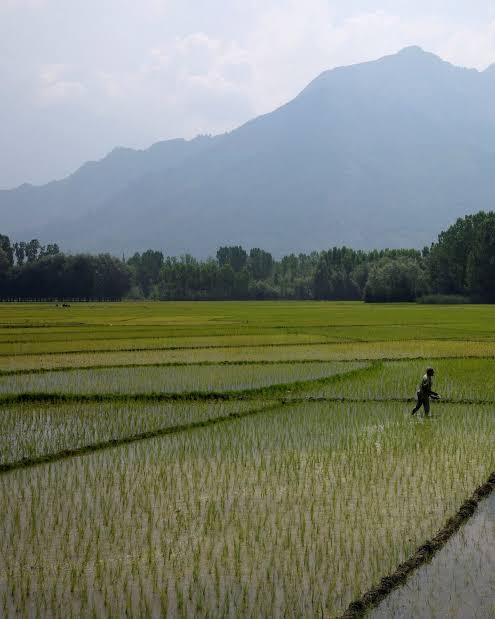
For millennia, the rhythms of planting and harvest have shaped human life, marking seasons of labour, renewal, abundance, and gratitude. This October, the Daily Classical Music Post will journey across eras and continents, celebrating harvest in the Northern Hemisphere and planting in the Southern through music inspired by the Earth and its changing seasons.
Monsoon Khayal | Raag Megh | Pandits Rajan & Sajan | Benares Gharana | Music of India
In today’s post, we return to something without which there would be very little to harvest at all: rain. In the Hindustani classical tradition of northern India, few ragas are more closely associated with rain than Raga Megh, one of the great musical evocations of the monsoon.
Raga Megh has no known composer or composition date. A raga is not a composition in the Western sense, nor is it simply a scale. It is a melodic framework with characteristic notes, phrases, and patterns of movement that musicians use as the basis for both composition and improvisation. Consequently, two performances of Raga Megh can sound quite different while remaining recognizably the same raga. Improvisation is fundamental to Indian classical music, making each performance unique.
The word megh means “cloud,” and Raga Megh is traditionally associated with the rainy season. It is generally a pentatonic raga, using five principal notes in ascent and descent, and its characteristic melodic movements create a spacious, weighty atmosphere particularly suited to the gathering of monsoon clouds. Indian classical music has long associated particular ragas with specific times of day and seasons; Raga Megh is traditionally performed during the monsoon, although it is also associated with midnight.
Raga Megh also belongs to a fascinating group of rain-associated ragas connected with Malhar. Tradition gives these ragas an almost supernatural power: properly performed, they are said to be capable of bringing the rain. One famous legend concerns the great 16th-century musician Miyan Tansen, at the court of the Mughal emperor Akbar. After Tansen performed the fire-associated Raga Deepak and was nearly consumed by its heat, the story says that a rain raga was sung to summon a storm and save him. The details vary considerably between versions, but the legend demonstrates just how powerful the connection between music and rain became in Indian musical culture.
For an agricultural society dependent upon the seasonal rains, the arrival of the monsoon is much more than a change in the weather. It makes the harvest possible. With Raga Megh, we look upwards to the clouds, which themselves have become a raga, carrying the promise of the water on which the fields, and ultimately the harvest, depend.
My classical music post for today is Rajan and Sajan Mishra: Raga Megh.


Leave a Reply