

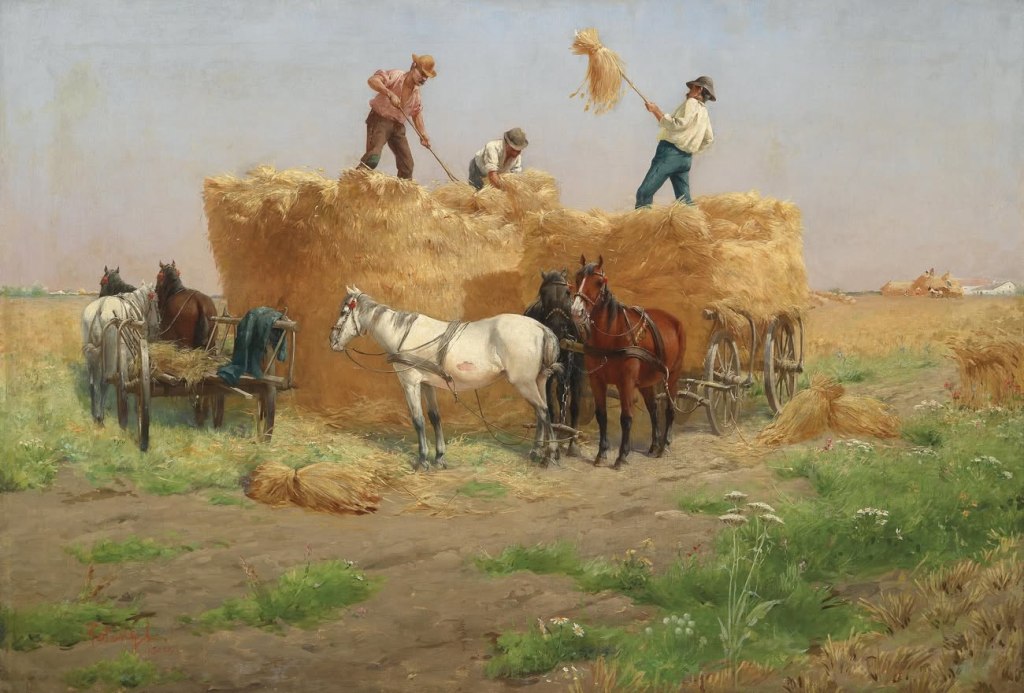
For millennia, the rhythms of planting and harvest have shaped human life, marking seasons of labour, renewal, abundance, and gratitude. This October, the Daily Classical Music Post will journey across eras and continents, celebrating harvest in the Northern Hemisphere and planting in the Southern through music inspired by the Earth and its changing seasons.
Bartok 44 duos – No. 12 Hay-Harvesting Song (Perlman, Zukerman)
Béla Bartók (1881–1945) was a Hungarian composer, pianist, and pioneering ethnomusicologist. Beginning in the early years of the 20th century, he travelled extensively through rural Hungary and neighbouring regions, recording thousands of traditional songs directly from villagers. Rather than merely borrowing picturesque folk tunes, Bartók studied their rhythms, scales, and melodic structures, and these all became fundamental to his own musical language.
Bartók’s Hay-Harvesting Song is No. 12 of his 44 Duos for Two Violins, Sz. 98, a wonderful collection in which music intended for young violinists becomes a miniature survey of the folk traditions of Eastern Europe and beyond. The 44 Duos were written in 1931 after the German violin teacher Erich Doflein asked Bartók for music for a new violin method. Doflein initially suggested arrangements of Bartók’s earlier piano pieces For Children, but Bartók instead produced a new collection for two violins. The pieces were progressively graded so that students could develop their technique while encountering the characteristics of traditional folk music. Most of the pieces are based on folk material from Hungary and surrounding regions and are based on Slovakian, Romanian, Ruthenian, and Serbian traditional music.
Hay-Harvesting Song is one of the simplest pieces in the collection. The two violins play short, clearly defined melodic lines, sometimes moving together and sometimes answering one another. There is none of the lush sound normally associated with a Romantic string piece. Instead, the spare texture and repeated rhythmic figures preserve something of the directness of traditional music of the countryside. Bartók takes material rooted in everyday life and places it in a concert and teaching context without disguising or losing its folk character.
Haymaking is, of course, a harvesting activity as well, although instead of gathering food directly for people, in this activity farmers are preserving grass and other forage to feed livestock when fresh pasture is no longer available. Cutting is only the beginning: the hay must dry sufficiently before it can be gathered and stored, making good weather particularly important. Bartók reminds us that the agricultural year also means preparing animals for the seasons ahead. A field of freshly cut hay may look like the end of the growing season, but in a farming community it also is preparation for the winter still to come.
My classical music post for today is Béla Bartók: 44 Duos for Two Violins, Sz. 98, No. 12: Hay-Harvesting Song.


Leave a Reply