

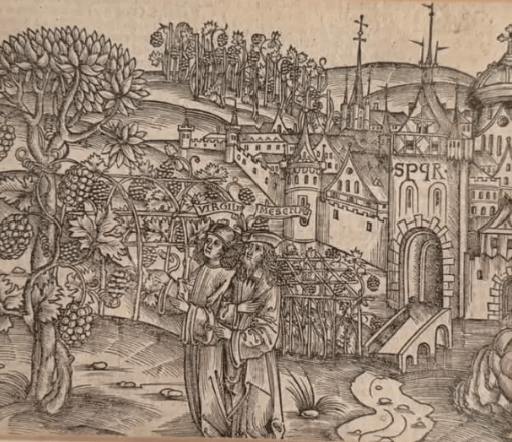
For millennia, the rhythms of planting and harvest have shaped human life, marking seasons of labour, renewal, abundance, and gratitude. This October, the Daily Classical Music Post will journey across eras and continents, celebrating harvest in the Northern Hemisphere and planting in the Southern through music inspired by the Earth and its changing seasons.
Margot labourez les vignes: Margot labourez les vignes
Jacques Arcadelt (c. 1507–1568) was a Franco-Flemish singer and composer who spent much of his career in Italy before eventually returning to France. He worked in Florence and Rome and sang in the papal chapel, and he later entered the service of Cardinal Charles de Lorraine in France. Arcadelt wrote sacred music and French chansons, but he is particularly remembered as one of the most important composers in the early history of the Italian madrigal. His enormously successful Il primo libro di madrigali, first published in 1539, went through numerous editions and helped establish the madrigal as one of the defining musical forms of the Renaissance.
“Margot, labourez les vignes” belongs to the lighter side of his music. It is a polyphonic chanson for four voices with a refrain, published in Paris in 1554 in the Tiers livre de chansons, issued by Adrian Le Roy and Robert Ballard. The words themselves are anonymous and appear to belong to an older popular song tradition. Arcadelt takes this simple memorable material and turns it into a piece of Renaissance part-writing in which four independent voices combine without sacrificing the infectious character of the original song.
The refrain tells Margot to work the vines—“Margot, labourez les vignes, / vignes, vignes, vignolet”—but the verses tell another story. Returning from Lorraine, Margot encounters three captains who insult her by calling her ugly. She answers them spiritedly: she cannot be so ugly, she says, because the king’s son loves her. In later versions of the song, he has given her a bouquet of marjoram; if it flowers, she will become queen. Like many popular songs that circulated for generations, the words survive in several forms, so the number and wording of the verses vary considerably.
The song also appears to have left a lasting trace in French popular culture. Musicological material from Radio France notes that “Margot, labourez les vignes” is probably an ancestor of the much later and still familiar French folk song “En passant par la Lorraine,” which retains Margot, Lorraine, the encounter with three captains, and the teasing over her appearance. It is a wonderful example of the porous boundary between “art” and popular music in the Renaissance: a melody and story could circulate orally, be transformed into sophisticated polyphony by a composer such as Arcadelt, and then continue evolving in popular tradition for centuries afterward. And the repeated command to work the vineyard is a reminder that the harvest of grapes—and ultimately the appearance of the wine on the table—begins with labour in the fields.
My classical music post for today is Jacques Arcadelt: “Margot, labourez les vignes.”


Leave a Reply