

For millennia, the rhythms of planting and harvest have shaped human life, marking seasons of labour, renewal, abundance, and gratitude. This October, the Daily Classical Music Post will journey across eras and continents, celebrating harvest in the Northern Hemisphere and planting in the Southern through music inspired by the Earth and its changing seasons.
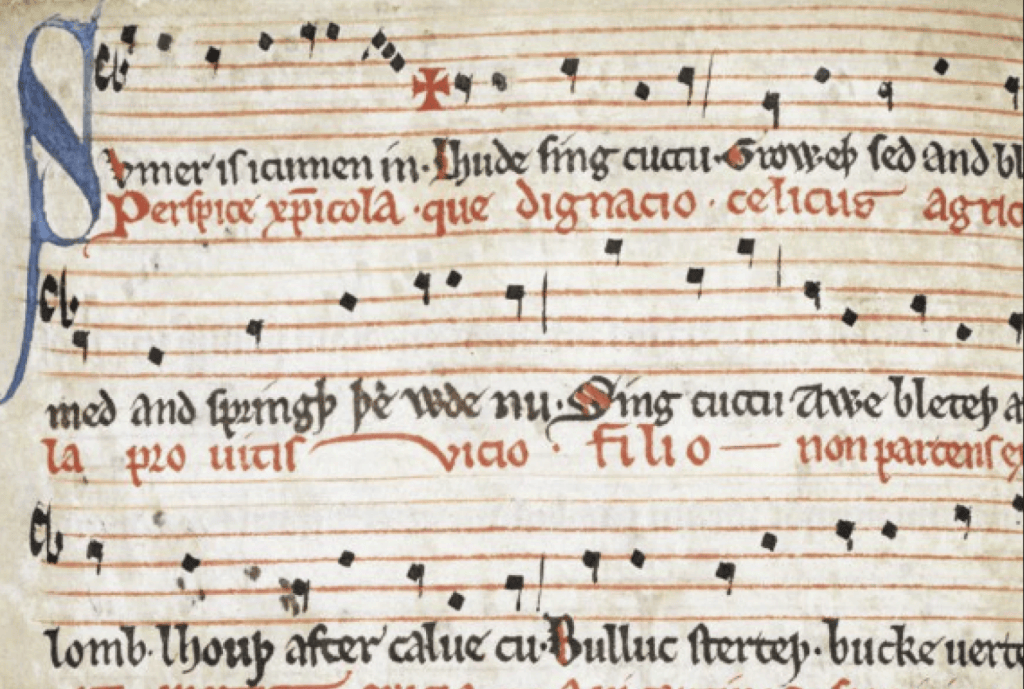
Sumer Is Icumen In is one of the oldest surviving examples of English secular music, dating from the mid-13th century. Its title means “Summer has come in,” and it is an exuberant celebration of the renewal of the natural world. Written in Middle English, its verses tell us that the seed is growing, the meadow is blooming, and the woods are coming into leaf, while the animals of the countryside join in the general awakening. The famous opening—“Sumer is icumen in, / Lhude sing cuccu”—calls on the cuckoo to sing loudly and announce the new season.
The piece survives in a manuscript associated with Reading Abbey in England and is generally dated to some time between 1250 and 1300. Its composer is unknown (yes, it is by our old friend Anonymous), and the manuscript provides unusually detailed instructions for its performance. It is a rota, or round: several singers perform the same melody, entering one after another, while two additional voices repeat a short underlying phrase known as a pes, or ground. The result is a remarkably sophisticated piece of six-part polyphony.
Despite its medieval origins, Sumer Is Icumen In has had a surprisingly long life in popular culture. Little John whistles its melody in the 1938 film The Adventures of Robin Hood. Benjamin Britten incorporated the medieval round into the climax of his Spring Symphony in 1949. The song was performed at the opening ceremony of the 1972 Munich Olympics. Most memorably (for me, anyway), it is sung by the islanders during the climactic final scene of the 1973 film The Wicker Man, where its celebration of the fertility and renewal of the natural world takes on a much darker meaning in a story centred on a failed harvest and the desperate hope for a better one. Their performance begins with the melody sung together before developing as a simple canon, rather than reproducing the elaborate six-part polyphony preserved in the medieval manuscript. I can’t hear this song without remembering the look on Edward Woodward’s face as he looked in the distance as Christopher Lee et al. sang and danced.
More than seven centuries after it was written, the little round celebrating growing seed, flowering meadows, and the coming of summer has proved remarkably difficult to leave in the Middle Ages. And this deceptively simple round reminds us that harvest begins long before anything is gathered from the fields.
My classical music post for today is Anonymous: Sumer is icumen in.


Leave a Reply