

Throughout history, myths and legends have brought ancient mysteries and epic sagas to life. This September, the Daily Classical Music Post explored how composers from different eras and continents have reimagined these stories through the universal language of music.
6. nat – 6. dag, Skabelsessymfonien
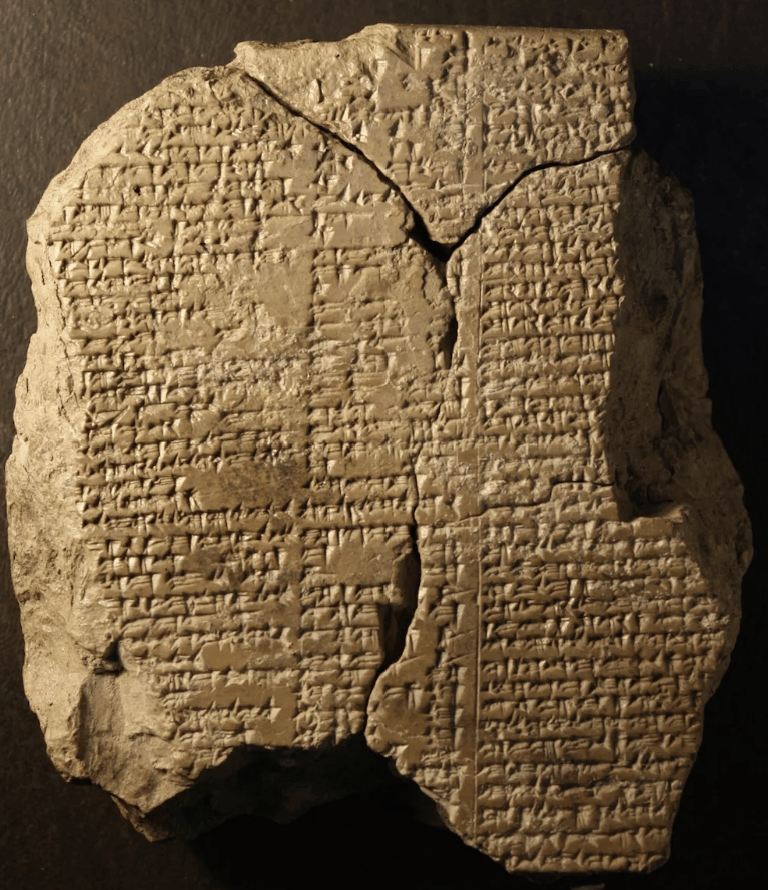
Stories of a massive and destructive flood appear in the history of almost every culture on every continent. Most of the stories have the survivors escaping the disaster on a raft or in a boat, and at least half of them have a chosen family that is given a warning. These stories include the myth of Deucalion and Pyrrha (Greek); the legend of Manu and the rescuing fish (Hindu); Noah’s Ark (biblical); deluge stories in the Hopi, Ojibwe, and Maya cultures; the tale of Mokdorung (Korean); several Dreamtime stories that actually can be traced to verifiable sea-level rise events (Aboriginal); and the subject of today’s selection, the catastrophic flood sent by the gods to destroy all humanity as told in the Sumerian Epic of Gilgamesh, preserved on clay tablets that were created more than four thousand years ago.
According to Tablet XI of the Epic of Gilgamesh, one of the oldest recorded flood myths, the god Enlil got really, really angry at the noise that humans were making, and so he convinced the other gods to wipe out all mortals with a massive flood. The god Ea secretly warned a human named Utnapishtim, instructing him to build a giant boat using materials from his house, and then load that boat with living creatures and the members of his family. After six terrifying days, the gods relented, and Utnapishtim’s boat came to rest on top of Mount Nisir. Enlil repented and granted Utnapishtim eternal life.
The Danish composer Per Nørgård (1932–2025) was a visionary. His music blended Nordic lyricism with mathematical innovations. His signature “infinity series” generated endlessly evolving melodic textures. He composed symphonies, opera, and chamber music that shift between serene beauty and chaotic expressionist energy. In 1972, he composed his opera Gilgamesh (subtitled Opera in Six Days and Seven Nights) with a libretto that he based on the Sumerian epic. His version focuses on the psychological transformation of humanity, moving from tyranny to self-awareness and brotherly love.
The retelling of the flood story unfolds fully during the Sixth Night (6. Nat). Gilgamesh travels to the ends of the earth and encounters the immortal sage Utnapishtim, who delivers his monologue detailing how the gods unleashed the apocalyptic deluge upon mankind and how he survived it. Nørgård’s “infinity series” and microtonal vocal lines mimic the unsettling and overwhelming sensation of rising and swirling water. A review of the opera said, “There is an alienness about the whole work, not least in its ritualistic atmosphere, that captures both the essence of the epic and the people that created it. Time and again one has the feeling of characters from some great carved frieze drawing breath as if for the first time.”
My classical music post for today is Per Nørgård: Gilgamesh: 6. nat – 6. dag.


Leave a Reply