

Throughout history, myths and legends have brought ancient mysteries and epic sagas to life. This September, the Daily Classical Music Post will explore how composers from different eras and continents have reimagined these stories through the universal language of music.
Vuorenpeikkojen iltasoitto, Op. 15/1
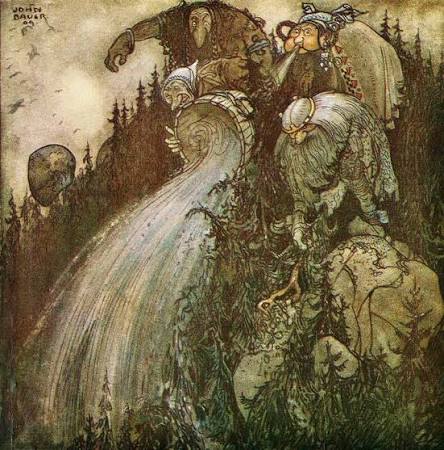
In Nordic folklore, trolls are mythical beings that were originally depicted as unpredictable and potentially dangerous but not inherently evil. They were very protective of the forests and mountains where they lived, and they had great affection for wild animals. In older Scandinavian folklore, trolls and humans got along pretty well, even helping each other out on occasion. However, with the arrival of Christianity, trolls became monsters, enraged by the sound of church bells. By the 20th century, the image of the troll was softened, making them more benevolent and less frightening.
The Finnish composer Heino Kaski (1885–1957) was particularly well known in his lifetime for his lovely piano miniatures and art songs, although he did write some larger-scale orchestral works as well. His music combines Late Romanticism, National Romanticism, and light Impressionistic soundscapes in a melodic, accessible, and evocative way. Jean Sibelius admired Kaski and supported the younger composer. In one of those weird twists of fate, Kaski died the day before Sibelius, and so his musical legacy was overshadowed by the passing of the composer celebrated as the titan of Finnish nationalism. It wasn’t until the 1990s that Kaski’s works were rediscovered by the world outside local Finnish circles and finally acknowledged for their brilliance.
The first of Kaski’s Piano Pieces, Op. 15 (1914), “Vuorenpeikkojen iltasoitto” (known in English as Evening Call of the Mountain Trolls or, sometimes, Mountain Trolls Play at Eventide), is one of his most popular works. Unlike Edvard Grieg’s “heavy” and menacing trolls, Kaski’s seem much more fun-loving and mischievous. Kaski captures the erratic nature of the trolls through specific and very detailed articulation markings in the score. The pianist is instructed to play lightly and in a detached manner in the right hand along with sudden accents that disrupt the rhythm, making sounds that are reminiscent of a troll stamping its feet. Tension builds slowly, and things seem to get slightly out of control before the piece resolves gently.
Jed Distler wrote, “If you’ve never heard of Heino Kaski (1885-1957) you’re not alone. Kaski primarily made his living as a music teacher in Helsinki, devoting his summer holidays to composing. His creative output largely consists of art songs and short piano pieces. The piano pieces may be modest in scope and ambition, yet they are long on communicative immediacy and melodic appeal. . . . The music is not trite, nor is it convoluted, and not one note is wasted: all hallmarks of a master miniaturist. ”
My classical music post for today is Heino Kaski: Piano Pieces, Op. 15/1: “Vuorenpeikkojen iltasoitto.”


Leave a Reply