

Throughout history, myths and legends have brought ancient mysteries and epic sagas to life. This September, the Daily Classical Music Post will explore how composers from different eras and continents have reimagined these stories through the universal language of music.
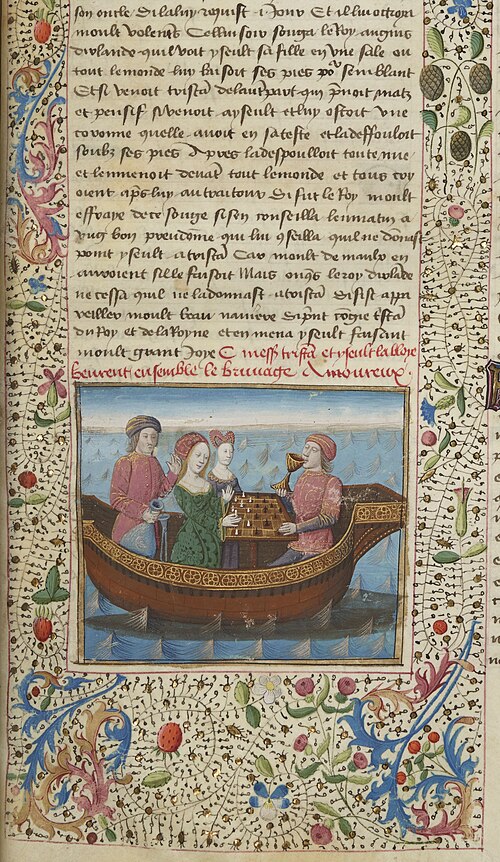
The tragic medieval legend of the romance between the Cornish knight Tristan and the Irish princess Iseult is one of the most famous love stories of all time. In the tale, dating from the 12th century, Tristan is sent to Ireland to bring Iseult back to Cornwall to marry his uncle, King Mark. Somehow on the ship on the way back Tristan and Iseult drink a love potion, and they fall deeply in love. In most versions of the story, although Iseult marries Mark, she and Tristan carry on a secret affair. They both die in the end either because Tristan is killed by Mark and Iseult dies from grief, or each of them is betrayed into thinking the other has died. In the 13th century, Tristan’s romance was merged into the Arthurian legend in the Prose Tristan. This Old French work was one of the most popular, influential, and copied stories in medieval European literature.
One of the versions of the Tristan and Iseult story was written by Marie de France in the late 12th century. Marie de France is the first known female poet writing in French. No one knows who she really was; in one of her poems, she wrote, “My name is Marie and I am from France,” so that became her name. She wrote 12 Breton lais (short medieval French lyric poems that are based on Celtic legend or are about a romance), all of which are preserved in a single manuscript.
One of these lais, “Le Lai du chèvrefeuille,” is the shortest lai in the collection. It tells the story of a secret meeting between Tristan and Iseult. Tristan carves his name on a hazel branch (coudrier) and places it along the road where Iseult will pass. The poem compares their love to the honeysuckle (chèvrefeuille) that intertwines with the hazel bush; neither can survive if they are torn apart.
Marie de France intended for “Le Lai du chèvrefeuille” to be performed by travelling jongleurs. It is very likely that more than one melody was written to these words, but none of the original tunes have survived. Scholars have tried to pair Marie de France’s Old French verses with medieval melodies that have survived.
For example, today’s selection sets Marie de France’s poem to music by our old friend Anonymous found in the Chansonnier de Noailles, a parchment manuscript dating from some time around 1300. There are monophonic songs and polyphonic motets as well as theatrical pieces in this collection. The decision to use this particular music for “Le Lai du chèvrefeuille” was a very good choice. The opening instrumentation sets a haunting tone, both reflecting the love between these two people but also hinting of the tragedy to come.
My classical music post for today is Anonymous: “Le Lai du chèvrefeuille.”


Leave a Reply