

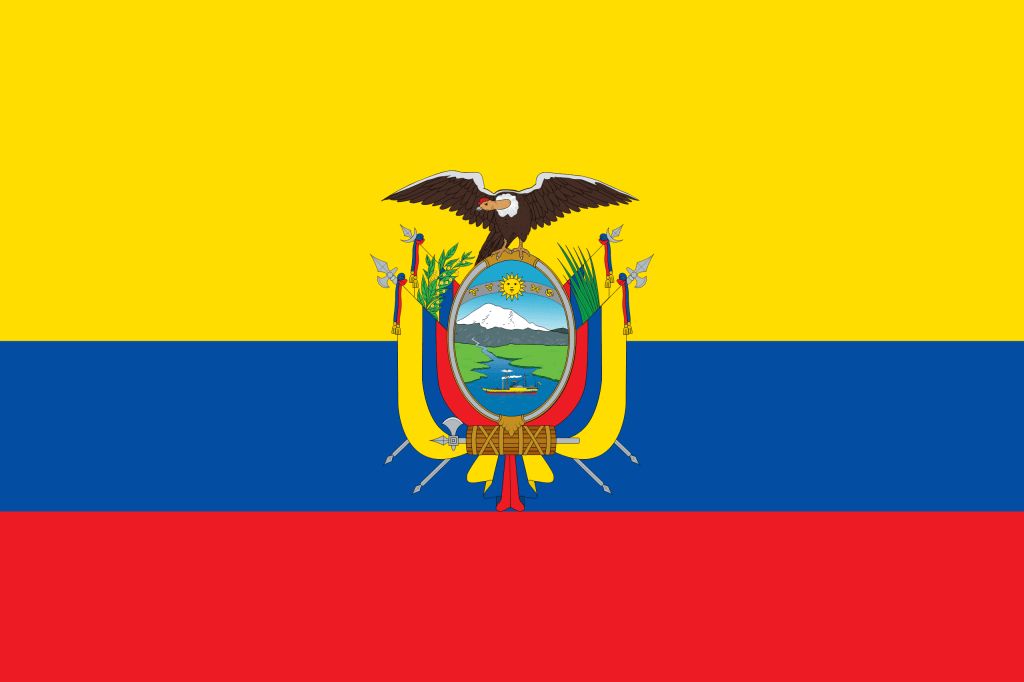
“If you were a country, what would your national anthem be?”—David Levithan
One of my favourite things about the 2026 FIFA Men’s World Cup was hearing some national anthems that I had never heard before as well as some that I rarely hear. And I wondered: How did each country choose its national anthem? Was it newly composed or taken from something already in existence? This August, the Daily Classical Music Post will explore the anthems of 31 of the 32 teams that made it to the knockout stage.
Ecuadorian National Anthem – “Salve, Oh Patria” (ES/EN)
We continue our exploration of the anthems of the countries represented in the 2026 FIFA Men’s World Cup knockout stage (minus the United States of America), in alphabetical order, with Ecuador.
Oh my! Yet another South American anthem that just stepped off the opera stage! The music for “¡Salve, Oh Patria!” was composed by Antonio Neumane (1818–1871), a German born in Corsica who studied at a conservatory in Vienna before moving to Italy to teach music, then to Chile to direct a choir, and then, finally, to Ecuador, where he became director of the national conservatory in Quito and President of the Ecuadorian Senate.
I guess what I am trying to say here is that Neumane had a lot of different influences in his life, and all of this is reflected in this very eclectic national anthem. A long introduction (during which you can visualise people in costume scurrying around on stage) finally gives way to the words by the Ecuadorian poet Juan León Mera Martínez. Although Mera wrote a chorus and six verses, usually only the second verse is sung, bookmarked by the chorus, as otherwise it would take more than three minutes to get through the whole thing.
There were a few unofficial anthems in Ecuador in the 19th century, but none of them “took.” It wasn’t until the Ecuadorian Senate commissioned Mera to write the words in 1865 and Neumane to write the music in 1866 that the idea of a national anthem really became a reality. The anthem premiered in 1870 and the performance was directed by the composer.
The long introduction of 16 measures was added in 1901 by the composers Domingo Brescia and Enrique Marconi; I’m not sure that was really needed. In 1913, someone tried to write new lyrics, but the legislature wasn’t having any of that. In 1948, Mera’s lyrics were finally declared official, and that was the end of revisions.
“¡Salve, Oh Patria!” is not an easy anthem to sing, but it’s a joy to listen to: the dynamic range, the vocal range, the drama! It’s definitely one of my favourites.
My (somewhat) classical music post for today is Antonio Neumane: “¡Salve, Oh Patria!”


Leave a Reply