

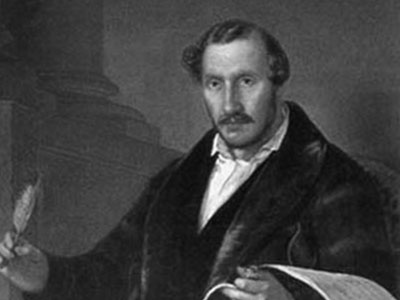
Classical music composition often runs in the family. This July, the Daily Classical Music Post will celebrate some of the well-known and not-so-well-known members of these composing families.
String Quartet No. 18 in E Minor: I. Allegro
When you hear the name of the Italian early-Romantic composer Gaetano Donizetti (1797–1848), you probably think of opera, and that is how his fame has continued to this day. But Gaetano was also a prolific composer of string quartets, and in fact he was the most important Italian composer of that genre in the 19th century, composing 18 quartets between 1817 and 1836.
Gaetano wrote his string quartets largely for private gatherings and in-home salon concerts. His quartets can be categorized into three distinct periods: the early quartets (Nos. 1 to 6); the theatrical quartets (Nos. 7 to 12); and the mature quartets (Nos. 13 to 18). The liner notes for a recording of the mature quartets said, “Knowing where to drop the needle on the string quartets of Donizetti presents more of a challenge than exploring the lasting treasures of his vast catalogue of operas, where posterity has already established a pecking order with Lucia di Lammermoor at its head. But Donizetti was more than a pioneer of bel canto, and the Quartetto Delfico present new recordings of three of the later and most richly developed examples of his mastery as a chamber-music composer, which sound no less assured and distinctive than his works for the stage. . . . [I]n No.18, Donizetti fully embraces the potential for the quartet as a medium of musical tragedy as potent as any abandoned heroine. This is a half-hour piece as ambitious and surprising as any of the mature quartets by his great predecessors in the medium, notable not just for an extended slow movement but also the nervous energy of its minuet.”
The String Quartet No. 18 in E minor, A 482 (1836) is universally seen as his ultimate chamber music masterpiece. Many scholars note that this work bridges the gap between strict Viennese classical structure, following on from the string quartets of Wolfgang Amadeus Mozart and Ludwig van Beethoven, and the emotional musical tragedy of Italian bel canto opera. But Gaetano also took on board more Romantic chamber music innovations like those in the chamber works of Franz Schubert.
One interesting side note about the first movement, Allegro, of the String Quartet No. 18: Gaetano was so pleased with this movement that he later recycled it in 1842 as the overture to his opera Linda di Chamounix. And this makes sense, as the lyrical violin lines have a quality that is very vocal.
My classical music post for today is Gaetano Donizetti: String Quartet No. 18 in E minor, A 482: I. Allegro.


Leave a Reply