

Classical music composition often runs in the family. This July, the Daily Classical Music Post will celebrate some of the well-known and not-so-well-known members of these composing families.
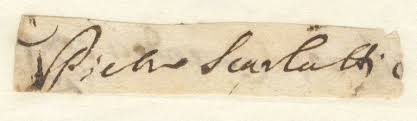
Pietro Filippo Scarlatti 1679-1750 Toccata in G minor Rosemary Oleary
Alessandro’s older son, the Italian Baroque Pietro Filippo Scarlatti (1679–1750) was nowhere near as prolific or as well known as his younger brother, Domenico. Pietro spent his entire career in Italy, whereas Domenico, wanting to get away from the influence of his father, moved to Portugal and Spain and achieved international fame.
All that remains of Pietro’s output is three cantatas and a small selection of keyboard toccatas. He worked as a choirmaster and, later, court organist. He followed his father’s example in writing for the stage, and what the cantatas reveal is that he was adept at creating multi-coloured sonorities and harmonies with attractive and simple melodic lines. His only opera Clitarco premiered in 1728, but the score was lost.
Pietro’s Toccata in G minor (date of composition unknown) is a virtuosic yet lyrical work. This multi-section bridges the late Baroque and early Classical periods, it functions as an expressive, multi-section showcase of melodic invention and keyboard agility shifts between free, improvisatory sections and strict, imitative counterpoint. The melodic lines are almost operatic in quality. Throughout, idiomatic Baroque ornamentations keep the work moving forward, and the dramatic swells and sighing motifs are also very operatic.
David Bolton wrote, “[Pietro’s] expertise at the keyboard was the cornerstone of his professional identity. While many of his contemporaries focused on the burgeoning operatic scene in Naples, Pietro Filippo was celebrated for his refined technique and his ability to weave complex contrapuntal textures on both the organ and the harpsichord. His playing style was characterized by a traditional Neapolitan elegance, favoring clarity and formal balance over the extreme, experimental virtuosity seen in his brother’s work. His keyboard output is best represented by his 21 Keyboard Toccatas. These works are essential to understanding the transition of the toccata from a strictly liturgical or pedagogical form into a more expressive, concert-style piece. Unlike the frantic energy of the late Baroque, Pietro Filippo’s toccatas often feature flowing scalar passages, intricate imitative sections, and a graceful use of ornamentation that reflects the ‘Galant’ style beginning to emerge at the time. These compositions serve as a bridge, maintaining the rigorous structural integrity of his father’s generation while introducing the melodic lyricism that would define the mid-18th century. Though his catalog is smaller than his kin’s, his works remain a sophisticated testament to the high standards of the Neapolitan keyboard school.”
My classical music post for today is Pietro Filippo Scarlatti: Toccata in G minor.


Leave a Reply