

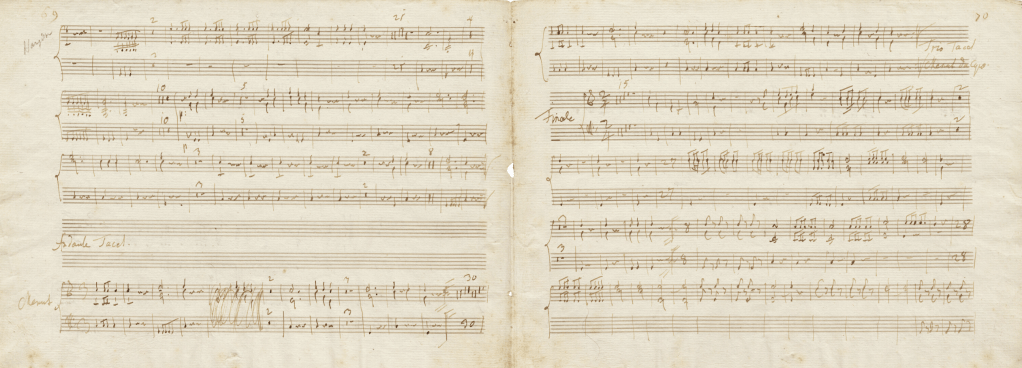
Classical music composition often runs in the family. This July, the Daily Classical Music Post will celebrate some of the well-known and not-so-well-known members of these composing families.
J. Haydn – Hob XXIVa:2 – Cantata “Destatevi o miei fidi”
One of the things that I love most about the Haydn family is that the mother and father of Joseph, Michael, and Hansl were not professional musicians; in fact, they couldn’t even read music. But they absolutely loved music, and they held regular musical gatherings in their home. They also encouraged and supported the musical education and development of all three of their sons, and the world of classical music was never to be the same.
The oldest son, the Austrian Classical composer Joseph Haydn (1732–1809), is one of the towering figures of classical music history. The “Father of the Symphony” and the “Father of the String Quartet” was one of the most prolific and influential composers in Western classical music history. In addition to his groundbreaking compositions, he taught and influenced musicians and composers not just in his lifetime but well beyond, even to the present day. Amongst his students were Ludwig van Beethoven, Ignaz Pleyel, Johann Nepomuk Hummel, and Louis Spohr. Composers who acknowledged his influence included Johannes Brahms, Sergei Prokofiev, Igor Stravinsky, and Thomas Adès.
Joseph (whose first name was Franz, but he was never called by that name) had two younger brothers: Johann Michael—called Michael—also was a composer (we will learn more about him tomorrow), and Johann Evangelist—called Hansl—who was a tenor of questionable talent but nonetheless was employed as a singer at the Esterházy court, where his older brother Joseph was Kapellmeister.
Joseph composed several works with a prominent tenor part, and it’s not difficult to imagine that he perhaps composed those works with his youngest brother in mind. One of these pieces was the festive cantata “Destatevi, o miei fidi” (Hob. XXIVa:2), which Joseph composed for the Esterházy court in 1763 to celebrate the name day (December 6) of Prince Nikolaus I “the Magnificent.” This cantata is a great example of Joseph’s early Eistenstadt period.
There are seven sections, or movements, in the cantata. Haydn later repurposed melodic motifs and dashing scalar figures from this cantata’s second movement, “Gran d’eroe,” for his wonderful Cello Concerto in C Major. This movement, for soprano and tenor solo, may very well have been composed for his youngest brother. At least, I’d like to think that’s what happened.
My classical music post for today is Joseph Haydn: “Destatevi, o miei fidi” (Hob. XXIVa:2).


Leave a Reply