

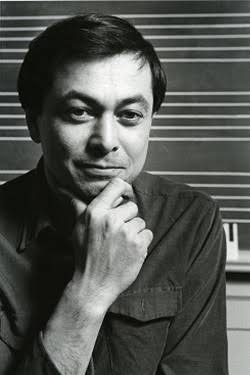
Classical music composition often runs in the family. This July, the Daily Classical Music Post will celebrate some of the well-known and not-so-well-known members of these composing families.
The Russian contemporary classical composer Ivan Tcherepnin (1943–1998) was, like his brother Serge, a pioneer in live electronic music, that is, performances in which a traditional musician would play and a synthesizer would alter their sound in real time. Ivan was not like other avant-garde composers at the time; his music was playful and joyful rather than intellectual and serious. Like his father Alexander, Ivan integrated Asian philosophy, microtones, and non-Western scales into his music.
Ivan’s Five Songs (1979) is a mesmerizing example of his boundary-pushing exploration of the borders between acoustic and electronic music. The titles of the songs in this 24-minute-long work are intriguing: 1. Do-Mi; 2. Après le Do-Mi; 3. Pfft!; 4. Queues; and 5. After the Queues (Tales). A review in Chicago Magazine said, “The songs’ format and texts explore the border zone between sense and nonsense, truth and deception, comedy and tragedy . . . the area between categories, where life mostly takes place.” Five Songs is for me magical, whimsical, psychedelic, and amazingly beautiful. And it is a perfect introduction to his music if you haven’t heard anything else by this fascinating composer.
Ivan wrote in his programme notes, “Five Songs was commissioned by WFMT-FM in Chicago as part of a project focusing on the twentieth-century art song, initiated by author/critic Karen Monson. . . . If one were to look for a theme in the cycle, it would be the very same theme as that of most songs since the dawn of music: Love (promised, betrayed, mischievous, chivalrous, yearned for, scorned, divine, profane, etc.). Musically, each piece is characterized by a distinctive use of voice and electronic ‘instrumentation.’ . . . The solfège syllables that are presented at the beginning of the songs gradually begin to resemble familiar words, to the point where they ‘take off,’ forming verselets—ditties that float on the surface of nonsense. . . . Throughout the piece, the text undergoes time-delayed electronic processing so that, in effect, the words watch different forms of themselves emerge instantaneously. . . . The piece comes to a close with the text of a medieval song whose tale, which has been retold by Hermann Hesse, rings a timeless truth: ‘Plaisir d’amour dure qu’un instant, chagrin d’amour dure toute la vie.’ And music remains after all else is forgotten.”
My classical music post for today is Ivan Tcherepnin: Five Songs.


Leave a Reply