

Classical music composition often runs in the family. This July, the Daily Classical Music Post will celebrate some of the well-known and not-so-well-known members of these composing families.
Fanny Mendelssohn: Easter Sonata in A Major / World Premiere (Century’s recording: Eric Heidsieck)
The German Romantic composer Fanny Mendelssohn (1805–1847) was, in many ways, more talented than her younger brother Felix, but she suffered from the prejudices against women composers (and women musicians in general) in the 19th century. Even her father was dismissive of her abilities; he told her once, speaking about her brother, “Music will perhaps become his profession, while for you it can and must be only an ornament.” Thanks, Dad.
Fanny composed close to 500 works, including piano pieces and songs as well as chamber music, and although some were published under Felix’s name, many were published under her name in her lifetime. Apparently some of her songs were particular favourites of Queen Victoria, even though the queen was under the impression that they had been composed by Felix. Fortunately, he owned up to the true authorship.
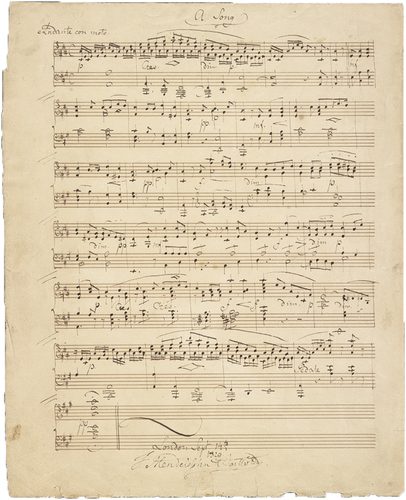
One of Fanny’s pieces that was attributed to Felix was the Osternsonate (Easter Sonata). The manuscript for this four-movement piano work was discovered in 1970, and because it just said “F. Mendelssohn” on it, everyone assumed that the “F.” was “Felix.” However, further research revealed that Fanny had mentioned this sonata in letters and in her diary at least one year after she completed the sonata on Easter Sunday in 1828. In 2010, the musicologist Angela R. Mace examined the manuscript closely and concluded definitively that Fanny did, indeed, compose it.
This monumental programmatic masterpiece follows a narrative arc from the crucifixion to the resurrection of Jesus. Fanny masterfully blended Beethovenian drama, Bachian polyphony, and Mendelssohnian lyricism. Movement 1, Allegro assai moderato, has a descending, sighing motif illustrating the struggle on the cross. Movement 2, Largo e molto espressivo, is a prelude and fugue, with quotes from a Lutheran hymn. Movement 3, Scherzo, has a theme similar to the theme of her piano cycle Das Jahr. Movement 4, Allegro, depicts the moment of Jesus’s death with dramatic tremolos in the bass mimicking thunder and the earthquake that split the temple, and concludes with a chorale based on Christe du Lamm Gottes, portraying the resurrection.
Hermione Lai wrote, “Composed when Fanny was twenty-three, it is a single-movement work in four interconnected sections, a form that blends sonata allegory with programmatic intent. . . . Stylistically, Fanny’s sonatas occupy a fascinating middle ground between Classicism and Romanticism. Like Beethoven, she privileges motivic development and cyclic integration. Yet her harmonic palette, rich in appoggiaturas, suspensions, and modal mixture, anticipates Schumann and Chopin.”
My classical music post for today is Fanny Mendelssohn: Osternsonate.


Leave a Reply