

Classical music composition often runs in the family. This July, the Daily Classical Music Post will celebrate some of the well-known and not-so-well-known members of these composing families.
Edvard Hagerup Bull: Symphony 6 [Dreier-RPO]
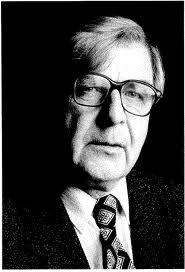
The Norwegian Modernist composer Edvard Hagerup Bull (1922–2012) was described by his teacher Darius Milhaud as “a musician with a solid technique and a truly very enthralling, vigorous and highly imaginative personality.” At the Paris Conservatoire, Edvard also studied with Olivier Messiaen and Jean Rivier. In Berlin, he studied with Boris Blacher and Josef Rufer. His music was not well-received in Norway, however, and so he returned to France in the early 1960s, where he was welcomed and received many commissions. Some of his pieces, including his trumpet concertos, were influenced by French jazz.
Ricardo Odriozola wrote, “Edvard Hagerup Bull is one of the great Scandinavian composers of the 20th Century, with an instantly recognizable and original voice. More than half of his production is still unpublished and only a fraction of his music has been recorded professionally. Performances of his music are, likewise, infrequent.”
Edvard was the first Norwegian composer to receive a commission from the French Ministry of Cultural Affairs—in fact, he received two commissions from that organization. His Concerto pour flûte et orchestre de chambre, Op. 33 (1969), was one of the works he composed for the commission, and the second was his Symphony No. 5, subtitled Sinfonia in Memoriam, Op. 41 (1972).
Symphony No. 5 is in four distinct movements, and the emotions move from a dramatic turbulence to a quiet sense of mourning. The work sits within a neoclassical framework; instead of rejecting strict avant-garde serialism in favor of highly organized polytonality, driving counterpoint, and rich instrumental colour. Bull masterfully blended the German modernism that he absorbed during his studies in Berlin with the more lively neoclassicism of the French composers who influenced his music.
Espen Selvik wrote, “I have to use strong words when judging the music [by Hagerup Bull]. It shows sparks of genius because it economizes with its means of expression in an incredibly clear and superior way. Not a single note seems wasted. At the same time, Hagerup Bull introduces small pauses of complete silence. I have seldom experienced a composer mastering the unfolding of form to the degree that Edvard Hagerup Bull does. The tonal language is powerful, but the energy has a continuous flow that unveils many nuances and colours along the way.”
[Note: the link to today’s post says Symphony 6, but it is in fact Symphony No. 5. The poster corrected the error in the comments.]
My classical music post for today is Edvard Hagerup Bull: Symphony No. 5, Op. 41.


Leave a Reply