

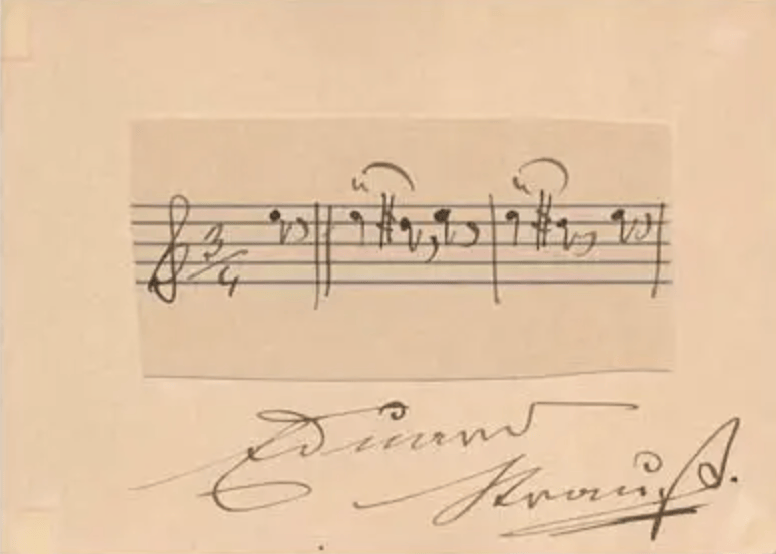
Classical music composition often runs in the family. This July, the Daily Classical Music Post will celebrate some of the well-known and not-so-well-known members of these composing families.
Eduard Strauss – Hellenen-Quadrille, op. 14
If Pepi was the reluctant genius, reserved and intense, of the Austrian Strauss family of composers, then the Romantic composer Eduard (1835–1916), known as “Edi,” was a showman, the ultimate professional and global ambassador for the family brand. He was the youngest and never thought that he would do anything other than create and perform music. He wanted to make his own mark as a composer, however, and he did this by writing quick polkas (“schnell Polkas”).
Eduard’s Helenen-Quadrille (Op. 14), also known as the La Belle Hélène Quadrille, is a lively orchestral piece. Composed in 1865, Eduard based the music on famous themes and melodies from Jacques Offenbach’s comic opera, La belle Hélène. It is in six sections: 1. Pantalon; 2. Été; 3. Poule; 4. Trénis; 5, Pastourelle; and 6. Finale. The piece is a masterclass in how 19th-century Viennese composers adapted Parisian stage hits for the local ballroom. By superimposing Offenbach’s satirical, operatic melodies onto a strict Austrian dance framework, Eduard created a work that is both musically rigorous and playfully theatrical.
Eduard used musical quotation and paraphrase throughout the piece. He used traditional Viennese orchestrations but expanded them, including brass fanfares and driving percussion to help the music fill the large Viennese dance halls. He changed the tempo and metre of Offenbach’s melodies to fit into a proper ballroom quadrille, with each movement in either 2/4 or 6/8 time. My favourite section is Poule: Eduard imitated the tradition “clucking” rhythm by writing short motifs that are tossed back and forth between the high woodwinds and low strings.
Eduard always felt overshadowed by his brothers. He was the last surviving member of the family, and in 1907 he presided over the burning of hundreds of unpublished Strauss family manuscripts. He claimed that he and Josef had made a pact that whoever outlived the other would destroy the unpublished manuscripts so that no outside composer could claim them. However, most of the destroyed manuscripts were of Josef’s music, and some historians believe Eduard wanted to avoid being unfavourably compared with Josef as well as with the far more popular Johann II. It was a sad end to a remarkable family legacy.
My classical music post for today is Eduard Strauss: Helenen-Quadrille.


Leave a Reply