

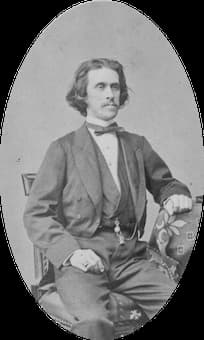
Classical music composition often runs in the family. This July, the Daily Classical Music Post will celebrate some of the well-known and not-so-well-known members of these composing families.
Die Ersten und Letzten, Op. 1: Die Ersten und Letzten, Walzer, Op. 1
The Austrian Strauss family were known for their light music and waltzes. Beginning in the early to mid-19th century with Johann Strauss I, the “Father of the Waltz,” and continuing with Johann Strauss II, the “Waltz King,” through to Johann Strauss III, this dynasty defined Viennese dance music well into the 20th century. I would venture to say that if you say “waltz” someone will immediately say “Strauss,” and vice versa.
Johann Strauss I had three sons, the most famous of which was Johann Strauss II. The middle son, the Romantic composer Josef Strauss (1827–1870) studied engineering, but the pull of the family business was too great, and he became a composer and conductor. He was known as “Pepi” by his family and close friends; Johann II is reported to have said, “Pepi is the more gifted of us two; I am merely the more popular.”
Josef’s first published work, a waltz in the form of a Ländler (an Austrian dance in ¾ time that was the precursor to the waltz) called Die Ersten und Letzten (The First and the Last), Op. 1, was composed in 1853. There is an irony in the title of the waltz. Josef was asked to take over from Johann II, who was ill, and in addition to conducting, he composed this piece that was meant to say, “I am doing this once to help my brother, and I am never doing it again.” However, the Viennese public adored the piece and clamoured for more. (Josef later poked fun at his failed ultimatum in his Op. 12 waltz Die Ersten nach den Letzten [The First After the Last].)
Josef went on to compose nearly 300 works, all dance music, including waltzes, polkas, and quadrilles, as well as marches. He also arranged hundreds of works by other composers. Josef was a big fan of Richard Wagner, and his music shows the influence of the German opera composer with unexpected modulations and the use of minor keys to create tension and a sense of mystery. Georg Predota wrote, “In his own compositions, Josef evidenced superior craftsmanship, and many of his melodies sound a melancholic charm that differentiates them from the music of his father and his brothers.” Norbert Rubey wrote, “Josef Strauss’s compositions have been described and characterised as ‘half the time happy, half the time sad’ by Hugo von Hofmannsthal and as ‘elegaically ecstatic’ by Hans Weigl.”
Josef was only 43 when he died of unspecified causes; he may have suffered a catastrophic head injury when he fell from a conductor’s podium during a concert, but there also were rumours that he was beaten by a group of drunken Russian soldiers who were angry that he wouldn’t perform for them.
My classical music post for today is Josef Strauss: Die Ersten und Letzten.


Leave a Reply