

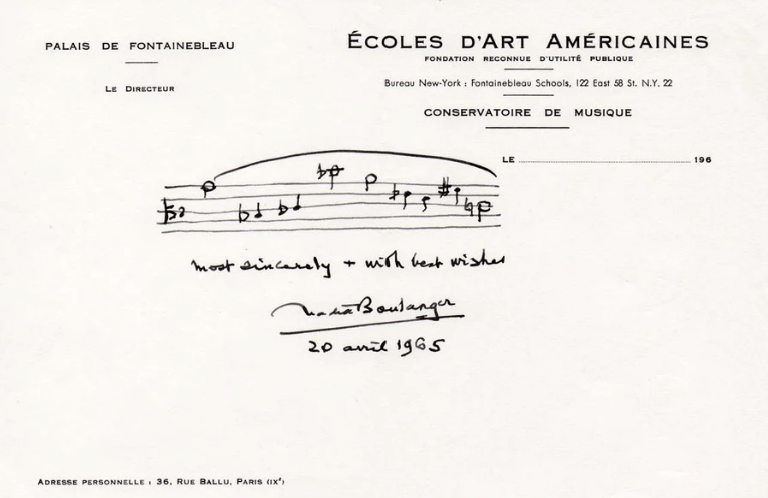
Classical music composition often runs in the family. This July, the Daily Classical Music Post will celebrate some of the well-known and not-so-well-known members of these composing families.
Nadia Boulanger Fantaisie pour piano et orchestre
Over the past two days, we heard music by two French brothers who composed in the late Classical/early Romantic eras. Today and tomorrow, we will listen to music by two French sisters who composed in the early 20th century when Romanticism was being overtaken by two French musical movements: Impressionism and Neoclassicism.
The French Romantic composer Nadia Boulanger (1887–1979) was probably the greatest music teacher in Western music history. Many important 20th century musicians, particularly composers, were her students, including Grażyna Bacewicz, Aaron Copland, and George Walker. Nadia’s parents were musicians: her mother was a singer, and her father, Ernest, was a Prix de Rome–winning composer and conductor. She studied composition with Gabriel Fauré and, in the 1904 Paris Conservatoire competitions, she came in first in three categories: organ, accompagnement au piano, and fugue (composition).
Nadia thought that her younger sister Lili was the real composer in the family. Nadia totally stopped writing music after Lili died; she told Fauré, “If there is one thing of which I am certain, it is that my music is worthless” (Fauré did not agree). Well, the minute I heard the opening notes of Nadia’s Fantaisie variée pour piano et orchestre (1912), I definitely disagreed with her assessment of her own music as well. The first two chords, in the low strings and bassoon, gripped me immediately.
Robert Hughill wrote, “Nadia Boulanger’s Fantasie variée for piano and orchestra was written for Raoul Pugno in 1912. . . . Dark and powerful, the Fantasie variée seemed to represent the illicit love-child of Sergei Rachmaninov and César Franck, with echoes of Liszt. [It is b]ased around a strong motto theme, which was subject to a series of variations creating a striking multi-sectional work. . . . You feel that the work is one Nadia Boulanger would surely have revised, had she not stopped composing. It is, however, a remarkable work, strong and full of drama, a reflection perhaps of the interior life of this fascinating woman.”
Norman Lebrecht wrote, “Written in six movements and lasting just under twenty minutes, you never know what Mademoiselle is going to come up with next. There is a certain amount of swashbuckling—this is 1912, long before Hollywood required film scores—and an obligatory Berliozian reference to the Russian Dies Irae, but the impression you get is of a hyperactive young woman, 24 years old, throwing everything in her kitchen, including the sink, into this pot-pourri of a score.”
My classical music post for today is Nadia Boulanger: Fantaisie variée.


Leave a Reply