

Classical music composition often runs in the family. This July, the Daily Classical Music Post will celebrate some of the well-known and not-so-well-known members of these composing families.
Hyacinthe’s older brother Louis-Emmanuel Jadin (1768–1853) was also a keyboardist as well as a composer. Interestingly, Hyacinthe was Louis-Emmanuel’s piano and harpsichord teacher for several years. Louis-Emmanuel was particularly popular in his lifetime for his operas comiques. He was actually quite prolific, although quite a lot of his music has been lost. He composed several works for wind instruments and wind band and some of his music was played during the French Revolution (Robespierre reportedly was a fan of Louis-Emmanuel’s wind band compositions in particular).
Even though Louis-Emmanuel produced a large body of work, it is not all that easy to find recordings of much of it, and I couldn’t find any recordings online of any of his operas (Lee Passarella wrote, “Louis-Emmanuel outlived his tragically short-lived brother by more than fifty years, producing a slew of operas [none of which, I’m pretty confident, you’ll ever hear.”]). What I could find definitely fit into the post-Revolution aesthetic in France, which specified that classical music should have, as James H. Johnson wrote, “predictable harmonies, and eminently singable melodies were the musical ingredients.” I was able to find Louis-Emmanuel’s beautiful and more expressive Nocturne in A minor for oboe and fortepiano, composed in 1816. This work is a great example of early-Romantic-era French classical music.
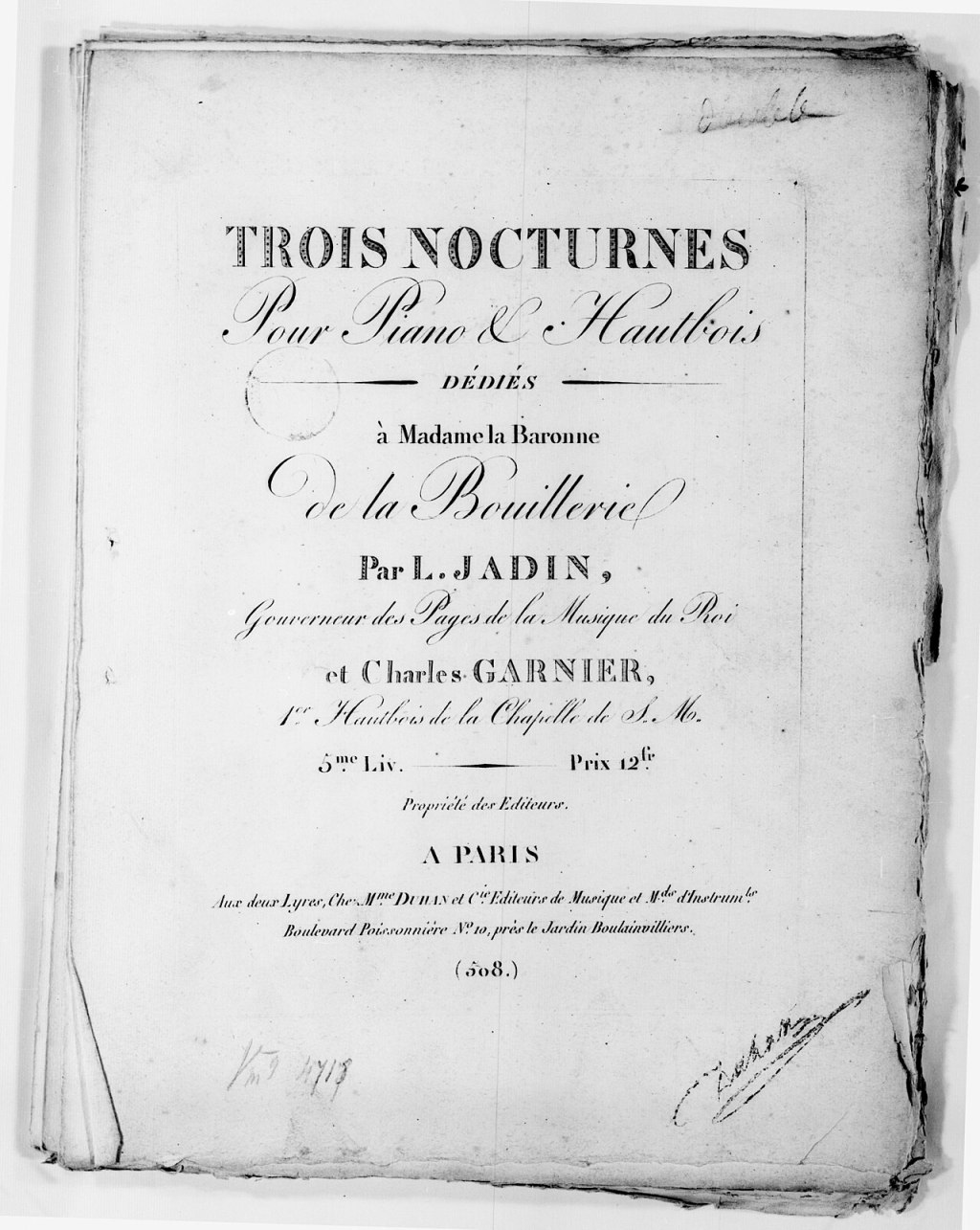
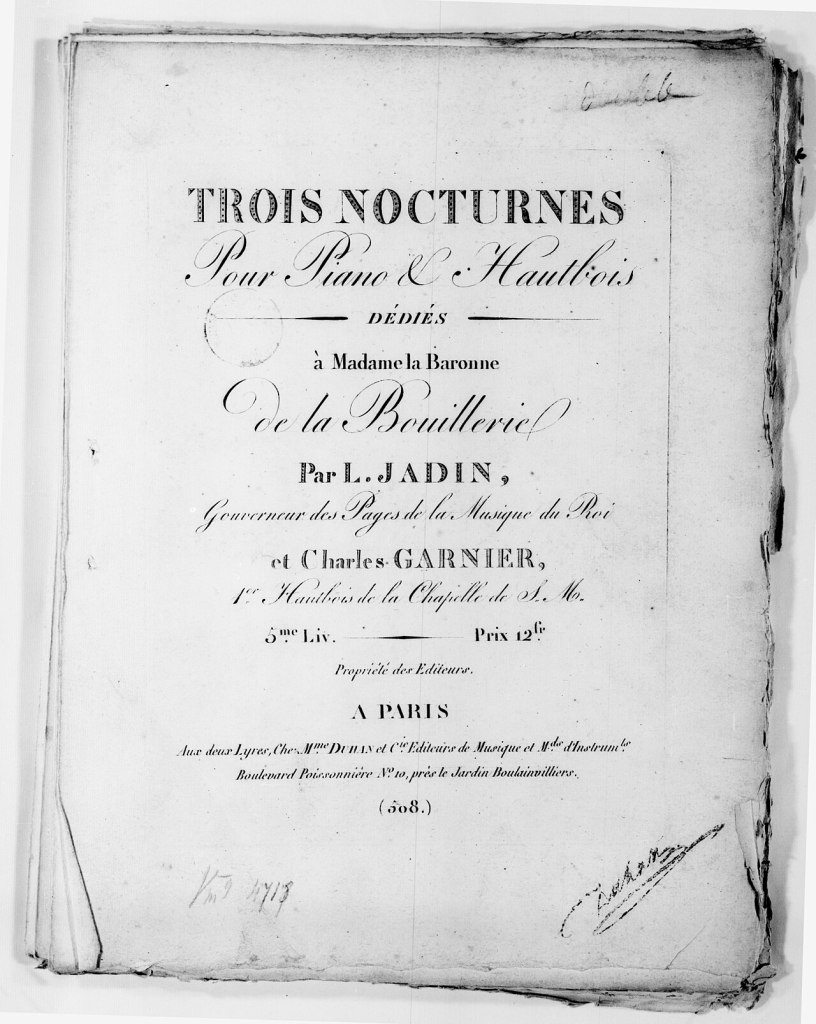
Louis-Emmanuel didn’t actually compose this nocturne (or the other two in the three-piece set) on his own. He collaborated on it with another French composer, Charles Garnier (not to be confused with the architect of the same name), who was also a professional oboist and so was responsible for the oboe parts and virtuosic musical ornamentations. (The title page says “Trois Nocturnes pour piano et hautbois . . . Par L. Jadin… et Charles Garnier.”) Louis-Emmanuel took Garnier’s solo lines, which the latter had adapted from popular songs so they fit into the oboe’s range, and composed the piano accompaniments, building out the underlying harmonies, rhythm layers, and structural support to turn the themes into true duo sonata-style chamber pieces.
In the liner notes accompanying a recording of the Nocturne in A minor, Christopher Palameta wrote, “The theme, the song ‘Ô ma tendre musette’ by Monsigny (itself based on the Breton canticle ‘Mealaka sa fizians, Guvere’hez en lo sikour’) is followed by a set of five variations (the fourth is in the major key while the fifth is a polonaise). . . . This nocturne is framed by sections where the oboe’s sweeping cantilena, marked maestoso, soars over broken arpeggios of considerable virtuosity in the piano. ”
My classical music post for today is Louis-Emmanuel Jadin: Nocturne in A minor.


Leave a Reply