

Classical music composition often runs in the family. This July, the Daily Classical Music Post will celebrate some of the well-known and not-so-well-known members of these composing families.
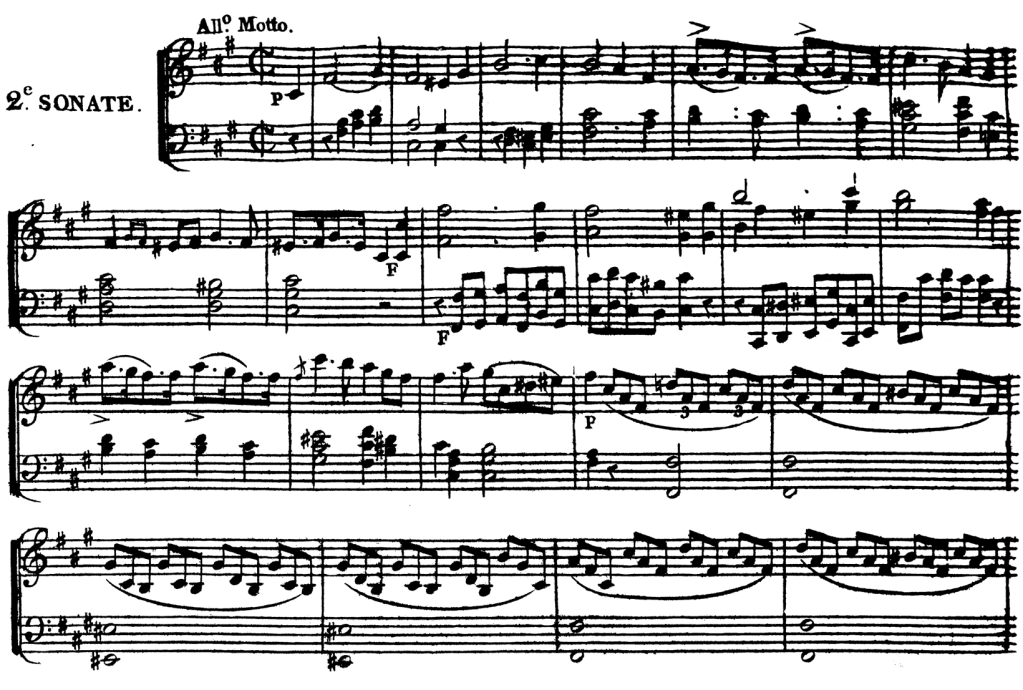
Sonate pour piano in F-Sharp Minor, Op. 4 No. 2: I. Allegro molto
The French Classical–early Romantic composer and keyboardist Hyacinthe Jadin (1776–1800) came from a family of musicians. His father, brothers, and uncles all were performers as well as composers. Hyacinthe published his first composition, a rondo for piano, when he was nine years old. Jean-Marc Warszawski wrote, “He composed operas that were not very successful, except for Cange, or Le commissionaire de Lazare, created in Paris, at the Théâtre des Amis de la Patrie on 21 1794 (the music is lost).” Hyacinthe’s chamber music was more successful, but it was his piano works that really made him stand out.
Jadin’s piano composition style was very progressive; his proto-Romanticism anticipated the piano sonatas of Ludwig van Beethoven and Franz Schubert. Ralph Graves wrote, “The bulk of Jadin’s compositions centered around the piano. Among them were six collections of piano sonatas. This release features the last three of the series. They were published between 1795 and 1800 (the year of Jadin’s death). These works have the balance and elegance of Classical Era works. In a sense, they emulate Haydn and early Mozart. But they’re also more developed than those models.”
James Methuen-Campbell wrote, “I am not one to believe that there are many hidden masterpieces lying abandoned on the shelves of music libraries. However, these sonatas by the French composer Hyacinthe Jadin (1776–1800) are to my mind quite equal in quality to the best by Dussek and deserve recognition as pieces that bridge the gap between the classical and romantic eras. The wholly individual use of rapid modulations and memorable melodic material leads one to marvel at the ease of craftsmanship. It is a tragedy that he died so young. . . . Despite the wealth of ideas, the overall effect is not fragmentary; these sonatas are put together with enormous self-confidence, and each is of a consistently high quality.”
The Piano Sonata in F-sharp Minor, Op. 4, No. 2 (1795), is considered by many scholars to be Hyacinthe’s best work. Marek Toporoski pointed out that when Jadin composed in a major key, as he usually did, the music is firmly in the Classical tradition, but when he composed in a minor key, “[h]e seems to look forward to another, more personal age of expression.” The first movement of this sonata is dramatic, lyrical, and virtuosic, and it makes me wonder, had he not succumbed to tuberculosis at the age of 24, who knows what he might have achieved?
My classical music post for today is Hyacinthe Jadin: Piano Sonata in F-sharp Minor, Op. 4, No. 2: I. Allegro molto.


Leave a Reply