

Classical music composition often runs in the family. This July, the Daily Classical Music Post will celebrate some of the well-known and not-so-well-known members of these composing families.
Ann-Elise Hannikainen Piano Concerto
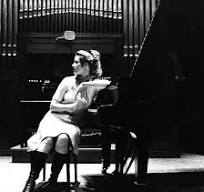
The Finnish composer Ann-Elise Hannikainen (1946–2012) was the great-granddaughter of P.J. Hannikainen. In her case, the desire to pursue a career in music passed over her grandfather, Lauri Hannikainen (who was a writer), and her father, Heikki Hannikainen (who was a diplomat). After studying music in Finland, in 1972 she moved to Spain, where she lived and worked until 1989. Most of her compositions were for the piano, either solo or in an ensemble, but she also composed chamber and orchestral music.
Marcus Virtanen wrote about the “typical features of Hannikainen’s music, such as soaring melodies, romantic glow and sudden shifts from one mood to another,” and how she often achieves a luminous quality in her works. She was adept at combining Nordic elements with Iberian ones, creating a unique musical landscape.
All of this can be heard in her 1976 work Concerto, in two movements, for solo piano and orchestra. Ann-Elise drew on Spanish neoclassical musical styles, particularly in her melodic tonality, and her harmonies and rhythmic sequences show the influence of Manuel de Falla, whose music and compositional techniques she had studied with Ernesto Halffter, one of de Falla’s most well-known students. Ann-Elise was a melodist as well as a modernist, a fascinating combination.
Susanna Mälkki wrote, “When rheumatoid arthritis put an end to a career as a concert pianist, [Ann-Elise Hannikainen] decided to concentrate on composing. . . . She composed her Piano Concerto of 1976 in honour of Falla on his centenary and it was premiered in Helsinki in that same year. The soloist was Hannikainen herself and the Helsinki Philharmonic was conducted by Falla’s best-known pupil, Ernesto Halffter; he was also her teacher and later her partner. The two-movement concerto got a mixed press in Finland but more favourable reviews in Spain.”
Marcus Virtanen wrote, “A menacing, slow ostinato pattern in the lower strings, repeated throughout the entire [first] movement, defines its character. . . . The second movement, Finale, is the true focal point of the concerto, where the soloist comes to the fore. As a whole, the concerto is characterized by a piano texture drawing on the late-Romantic piano concerto tradition, colorful orchestration, and a formal language built on strong contrasts and juxtapositions.”
My classical music post for today is Ann-Elise Hannikainen: Concerto.


Leave a Reply