

Classical music composition often runs in the family. This July, the Daily Classical Music Post will celebrate some of the well-known and not-so-well-known members of these composing families.
The Finnish Romantic composer P.J. Hannikainen (1854–1924) was the patriarch of a prominent family of musicians; tomorrow, we’ll be learning about one of his descendants. P.J. reportedly expected all of his children to become musicians, and it so happens that four of his six children—composer Arvo Hannikainen, composer Väinö Hannikainen, composer Ilmari Hannikainen, and cellist Tauno Hannikainen—did just that. The Hannikainen family was also highly regarded in Finnish literary and political circles.
P.J. was also a writer, and many of his more than 200 choral works, hymns, and songs were set to his own poems. He also collected, adapted, and arranged many Finnish traditional tunes. His works were often patriotic, contributing to the Finnish national identity at a time when the country was under Russian rule. P.J., who had studied philosophy at university, was part of the Fennoman movement in Finland in the late 19th century, and he set his texts in Finnish rather than in Swedish, which up to then had been the standard language of art music, literature, and official business. P.J. also founded the YL Male Voice Choir as well as the Mieskuoro Sirkat choir, and he was the editor of the first Finnish music magazine, Säveleitä.
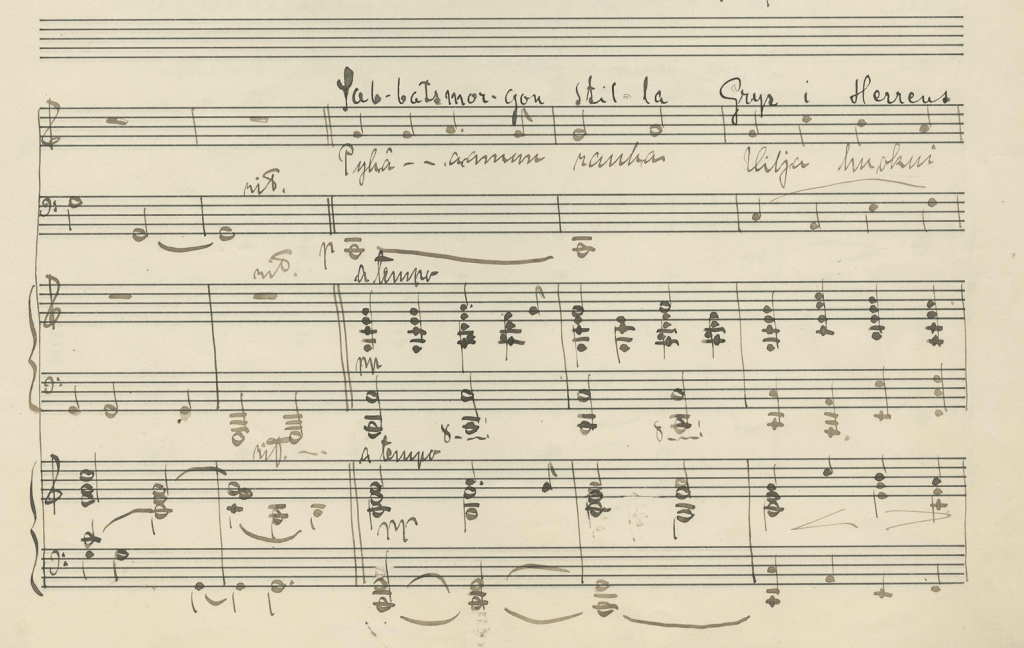
In 1900, P.J. composed “Pyhäaamun rauha” (The Peace of the Holy Morning), to lyrics by Bishop Herman Råbergh. This hymn, written originally for voice, cello, piano (or harp), and harmonium, has been arranged for a cappella choir, and choir with organ. The words describe a calm and tranquil Sunday morning, and the music beautifully reflects that serenity. This is one of the most sung sacred songs in Finland; people sing it during church services as well as at classical concerts.
In 2022, a choral composition competition was set up in P.J.’s name, to honour his legacy and to encourage composers to write modern yet approachable music that local and amateur choirs can easily adopt into their repertoires. The competition also looks to expand availability of pieces for mixed, female, male, and children’s choirs.
My classical music post for today is P.J. Hannikainen: “Pyhäaamun rauha.”


Leave a Reply