

Classical music composition often runs in the family. This July, the Daily Classical Music Post will celebrate some of the well-known and not-so-well-known members of these composing families.
Wilhelm Friedrich Ernst Bach (1759-1845) – Westphalens Freude (1791)
We’ll finish our brief look at some members of the Bach family with the German Classical composer Wilhelm Friedrich Ernst Bach (1759–1845). W.F.E. Bach, known as Wilhelm Bach or, sometimes, as Ernst Bach, was the last direct descendant of J.S.; his father was J.C.F. Bach. Wilhelm was the only one of his generation of Bachs to achieve success as a composer. Although he allegedly once said, “heredity can tend to run out of musical ideas,” he actually had lots of good musical ideas as well as a fine sense of humour.
Georg Predota wrote, “His most famous composition . . . is called Das Dreyblatt (The Threesome). Scored for one piano and six hands, the music features a male performer flanked by two female pianists. The male pianist sits in the middle and has to stretch his arms around the waists of his accomplices to play at the extreme ends of the keyboard. The ladies, meanwhile, play all parts in the middle register.” Weirdness and creepiness aside, Das Dreyblatt is a quite light and delightful short piece (Wilhelm Friedrich Ernst Bach – Das Dreyblatt for six hands.).
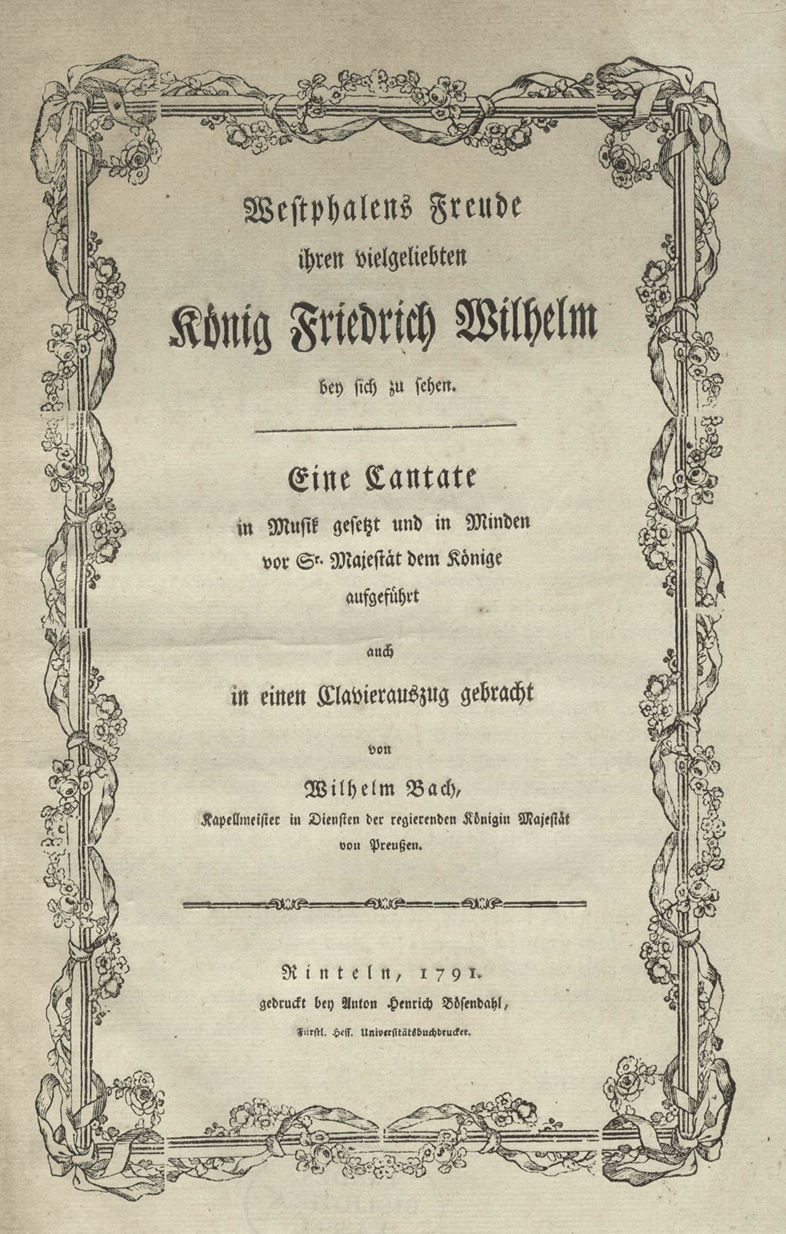
Wilhelm’s 1788 secular cantata Triumph! Triumph Westphalia! is a great example of his graceful compositional style, which combines the strict counterpoint of his famous ancestor with the elegance of Classical forms. This work, also known as “Westphalens Freude ihren vielgeliebten König Friedrich Wilhelm bey sich zu sehen. Eine Cantate in Musik gesetzt und in Minden vor Sr. Majestät dem Könige aufgeführt auch in einen Clavierauszug gebracht von Wilhelm Bach” (Westphalia’s joy to see their much-beloved King Friedrich Wilhelm among them. A cantata set to music and performed in Minden before His Majesty the King, also arranged for keyboard by Wilhelm Bach), was composed for SATB soloists, choir, strings and basso continuo, flutes, oboes, and horns. Wilhelm skilfully blended the older tradition of German gelegenheitsmusik (occasional music) with the lighter, galant idioms of the late 18th century.
There is a story (probably true) that Wilhelm composed the cantata while he was employed as Kapellmeister in Minden. The king of Prussia, Friedrich Wilhelm II, heard the work, and he was so impressed that he immediately offered Wilhelm the position of Kapellmeister to the court in Berlin, a post that he held for almost 25 years.
My classical music post for today is Wilhelm Friedrich Ernst Bach: Triumph! Triumph Westphalia!


Leave a Reply