

June is the sixth month in the Gregorian calendar, which is the calendar most in use throughout the world. This June, the Daily Classical Music Post will explore chamber music, choral music, and operatic sextets from the Renaissance to the 21st century.
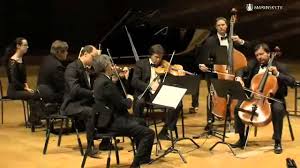
Mikhail Glinka: Grand Sextet in E Flat Major, Mikhail Pletnev (piano) & The Soloists Ensemble
The Russian early Romantic composer Mikhail Glinka (1804–1857) is considered to be the father of Russian nationalist classical music, mainly because he influenced so many 19th-century Russian composers, in particular Mily Balakirev, César Cui, Modest Mussorgsky, Nikolai Rimsky-Korsakov, and Alexander Borodin (known as “The Five”). Glinka believed that his mission in life was to compose in a Russian style and help to create a Russian nationalistic form of music. His operas and ballets are the best examples of this.
Glinka often suffered from ill health, and in 1830 his doctors suggested that he get away from the harsh climate in Russia and travel to Italy where it was warmer and sunnier, as that might make him better. He spent several years living and studying composition, particularly opera composition, in Milan. Willard J. Hertz wrote, “Glinka composed [the] Grand Sextet in 1832 while he was living in Milan and was preoccupied with writing opera. Taking in opera at La Scala as often as possible, he came under the influence of several Italian composers, in particular Donizetti. The influence of Italian opera can be felt in the melodic content and joie de vivre of the sextet.”
The Grand Sextet was composed for two violins, viola, cello, double bass, and piano. Apparently, Glinka was enamoured with the married daughter of his Italian doctor and wrote the piano part for her. He wrote in his memoirs, “I naturally visited de Filippi’s daughter frequently—the similarity of our upbringing and our passion for the same art could not but bring us together. Because of her interest in the piano I began for her a ‘Sestetto Originale,’ but later on, having finished it in the autumn, I was compelled to dedicate it, not to her, but to a female friend of hers.” The change of dedication was to stop gossip, apparently. As there doesn’t seem to be any evidence of a scandal, I guess that worked.
The first movement—Allegro—is in sonata form, and there are hints of Italian opera music particularly at the start of the second theme. The second movement—Andante—opens with a long Chopinesque piano solo; the middle section features a duet for the violins. The third movement—Finale. Allegro con spirito—is jubilant and once again the piano dominates; the middle section is reminiscent of a Czech polka.
My classical music post for today is Mikhail Glinka: Grand Sextet in E-flat Major.


Leave a Reply