

June is the sixth month in the Gregorian calendar, which is the calendar most in use throughout the world. This June, the Daily Classical Music Post will explore chamber music, choral music, and operatic sextets from the Renaissance to the 21st century.
Sextet: I. With Fluctuating Tension
The German-born American composer Ursula Mamlok (1923–2016) cited Paul Hindemith, Arnold Schoenberg, Anton Webern, and Alban Berg as her main influences. She said in an interview, “My music is colorful, with the background of tonality—tonal centers. . . . I can’t shake it completely. . . . My main concern is that the music should convey the various emotions in it with clarity and conviction.” Many of her compositions were for small chamber ensembles, and she also composed for full orchestra and voice.
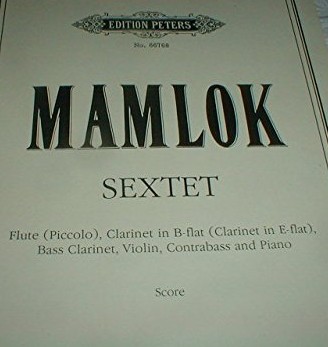
Mamlok has described her Sextet (1977) for flute, clarinet, bass clarinet, violin, double bass, and piano as one of her most important pieces. She wrote in the programme notes, “My sextet is built around a central tempo (72 quarternotes per minute). In the first movement, marked with fluctuating tension, four interrelated tempos are active at the same time, creating a dense texture similar to a rapid discourse among six people. A contrasting section follows, a thinner texture of solos and their ‘mirrors’ that preserves the four tempos of the preceding section. The first section is then repeated with varied details. A transition leads to the second movement. This movement, an ABCBA form, presents a very calm and lyrical opening (part A), which gives way to a section of intense five-part counterpoint (part B). After a dance-like ostinato section (part C), transformed versions of B and A return. A violin harmonic acts as a bridge to the third movement, marked light and airy. This cheerful rondo has a bravura conclusion, fortissimo, that leaves the flute and clarinet lines suspended in mid-air.”
Stuart Sillitoe wrote in a review that the first movement, “With fluctuating tension,” is “a fine example of serialism technique.” Sextet was commissioned by Parnassus, a New York–based ensemble dedicated to commissioning and performing new music. In addition to premiering the work in 1977, they also performed it on the recording shared today. As with Mamlok’s other works, this is challenging to play as well as to hear, but the expressive and dramatic nature draws in the listener. Sextet is more atonal than her earlier (and much later) works, and perhaps leans more towards the intellectual rather than the emotional, but it is nonetheless a good introduction to the music of this fascinating composer.
My classical music post for today is Ursula Mamlok: Sextet: I. With fluctuating tension.


Leave a Reply