

June is the sixth month in the Gregorian calendar, which is the calendar most in use throughout the world. This June, the Daily Classical Music Post will explore chamber music, choral music, and operatic sextets from the Renaissance to the 21st century.
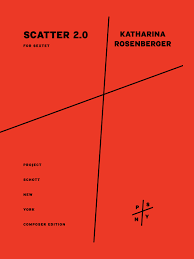
Scatter 2.0 by Katharina Rosenberger
The Swiss composer Katharina Rosenberger (born 1971) has won many commissions and awards for her interdisciplinary works that include concert music, musical theatre, sonic art, and sound installations. Rosenberger composed scatter 2.0 in 2010; this piece is a revision of scatter, which she composed in 2009 to a commission from the Ensemble Für Neue Musik Zürich. The instrumentation of scatter 2.0 is flute, clarinet, percussion, violin, cello, and piano.
Rosenberger wrote in her programme notes, “scatter 2.0 is movement—a chase, a pursuit, a run in all directions, regrouping at times, then falling apart again, a split, splinters or sparks, disperse or dissolve . . . these moments of agitation are depicted in three different segments that overlap and share similar material in ever-changing configurations. The listener could imagine looking through a kaleidoscope, turning and shaking the tube at various speeds, to observe the ‘action-patterns’ collapsing and reassembling into new constellations and images. It is this interplay of contrasting formations that scatter to the very highest or lowest, rumbling registers, that temporally press ahead or stutteringly pull back the flow, and that ultimately drive the music forward, reinforcing the scattered evolution of the piece.”
Steven Schick wrote, “Swiss composer Katharina Rosenberger’s scatter 2.0 consists of a series of small, shall we say scattered, phrases that seem to be moving towards a complete thought. In a way the piece is misnamed since it starts with disconnected cells that are fractured by a frenzy of meter changes and gradually coalesces to lengthier phrases and more complete ideas. Perhaps it would be more accurate to call it ‘Gather.’ But either way it’s the tension between momentum and position that I find appealing as fragments of ideas migrate and merge to wholeness.”
Raul d’Gama Rose wrote, “Composed for sextet, the woodwinds, strings and percussion are featured in glorious pursuit of each other. The timbral elegance and splashes of tonal color make this lively piece an absolute delight, even in the tense energy of the composition’s middle section.”
My classical music post for today is Katharina Rosenberger: scatter 2.0.


Leave a Reply