

June is the sixth month in the Gregorian calendar, which is the calendar most in use throughout the world. This June, the Daily Classical Music Post will explore chamber music, choral music, and operatic sextets from the Renaissance to the 21st century.
Nabucco, IGV 19, Act I: “Che tenti?… Oh trema, insano!” (Zaccaria, Nabucco, Fenena,…
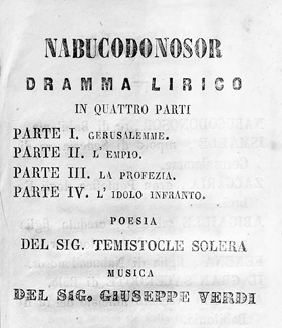
The Italian composer Giuseppe Verdi (1813–1901) said of his opera Nabucco (1841)—original title Nabucodonosor—that “this is the opera with which my artistic career really begins. And though I had many difficulties to fight against, it is certain that Nabucco was born under a lucky star.” The story of Nebuchadnezzar, based on the Bible and Auguste Anicet-Bourgeois and Francis Cornue’s 1836 play, was Verdi’s third opera. The libretto was by Temistocle Solera and there is, of course, a wholly invented romantic plot that unfolds alongside the political one.
A Metropolitan Opera guide summary of Act I says, “Nabucco, King of Babylon, leads an army to Jerusalem, determined to conquer the city and enslave the Israelites. Abigaille, Nabucco’s daughter, arrives just before the approaching army and offers to save the Israelites—but only if Ismaele, nephew of Jerusalem’s king, will return her love. He refuses, for he is already in love with Abigaille’s sister Fenena, who is being held hostage by the Israelites and has converted to Judaism. Abigaille swears vengeance as Nabucco arrives and orders the Temple of Solomon burned to the ground.”
The Act I scene 9 sextet “Che tenti? Oh trema, insano!” (What are you trying? Oh tremble, insane!) begins when Nabucco and the Babylonians arrive at the entrance to the temple. The high priest, Zaccaria, tells him that he needs to go before he profanes the holy place; Nabucco ignores him. Fenena and Abigaille try in their different ways to stop Nabucco, and Ismaele, Zaccaria, Zaccaria’s sister Anna, and the Israelite chorus plead for their lives.
Everything is laid out in this scene—the rivalries, the plight of the lovers, the anger of the various characters—and Verdi expresses all of this brilliantly in the music and the way the singers interact with each other. This is an excellent example of Verdi’s pezzo d’iniemes (large ensemble pieces). The tension builds slowly: the characters enter one by one, resulting in dense polyphony with a relentless ticking pulse in the orchestra, reminding the audience that destruction and death could happen at any time.
Nabucco was an immediate success, and “Va, pensiero” (The Chorus of the Hebrew Slaves), became one of Verdi’s most famous choruses. Opinions are divided on just how much Verdi intended this chorus as an anthem for Italian patriots, but in any event it has become associated with various political movements and events. And when Verdi died, mourners lined the streets of Milan and spontaneously began singing “Va, pensiero.”
My classical music post for today is Giuseppe Verdi: Nabucco: Act I: “Che tenti? Oh trema, insano!”


Leave a Reply