

June is the sixth month in the Gregorian calendar, which is the calendar most in use throughout the world. This June, the Daily Classical Music Post will explore chamber music, choral music, and operatic sextets from the Renaissance to the 21st century.
The American composer Elliott Carter (1908–2012) moved through early tonal and neoclassical phases to become one of the most respected modernist composers in the second half of the 20th century. His style combined European modernism and U.S. American ultra-modernism with his own personal harmonic and elaborate rhythmic patterns. He never used serial techniques; his early works are mostly diatonic and his later music is chromatic. He died one month before his 104th birthday, and he was still composing right up to the end.
Tintinnabulation, written for percussion sextet in 2008, is characterized by what some critics have called Carter’s “rhythmic chaos.” Carter wrote in his programme notes, “When the wonderful percussionist, Frank Epstein, suggested I write a percussion piece for his group of six players, a section of the orchestra I had often used as an independent entity, I agreed. Deciding not to use pitched percussion (marimba, vibraphone, etc.) I chose a large range of different sounding instruments. The work is in three important sections—wood, metal and skin—each of the six players has some instruments from each group. These instruments often can be played in different ways, for example with different mallets on different surface locations. The piece was composed in New York City, begun in the fall of 2007 and finished on April 19, 2008.”
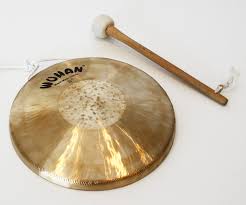
A review of the premiere in The Boston Globe said, “Carter had never written for solo percussion ensemble before but that clearly did not stop him from bending this configuration to his own composerly aims with extraordinary precision. ‘Tintinnabulation’ covers an enormous range of sonorities, partly through Carter’s choice of instruments (a Chinese opera gong and five types of nipple gongs are among the mix) but also through his meticulous instructions of where to strike each instrument and what kind of stick to use, be it a mallet, a brush, a birch dowel, or even a knitting needle.”
Talia Amar interviewed some of Carter’s friends and colleagues a few years after his death. John Heiss told a fun story about the premiere of Tintinnabulation: “Frank Epstein commissioned him to write his first percussion ensemble piece, which he did at the age of 99, a fantastic work called Tintinnabulation (2008). I sat next to him during the performance and he was laughing and laughing. So after the performance I asked him ‘Why are you laughing?’ and he said: ‘John, it works!’”
My classical music post for today is Elliott Carter: Tintinnabulation.


Leave a Reply