

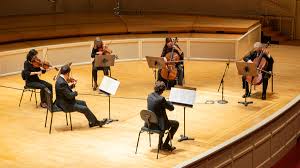
June is the sixth month in the Gregorian calendar, which is the calendar most in use throughout the world. This June, the Daily Classical Music Post will explore chamber music, choral music, and operatic sextets from the Renaissance to the 21st century.
String Sextet in E-Flat Major, Op. 44: I. Andante – Allegro vivace
The Danish Romantic composer Niels Gade (1817–1890) was one of the leading musicians of the Danish Golden Age, and he also was an exceptional violinist, which is how he first came to the attention of Felix Mendelssohn and Robert Schumann, who became champions of his compositions as well as close friends. Gade’s influence can be seen in the next generation of Scandinavian musicians, including one of his students, the great Danish composer Carl Nielsen, and the great Norwegian composer Edvard Grieg. Even today, although Gade is not well known in the rest of the world, he is still held in the highest regard in Denmark.
In 1998, R. Larry Todd wrote, “As the twentieth century draws to a close, there are striking signs of a renewal of interest in this regrettably neglected composer. . . . The rediscovery of Gade’s music will no doubt yield valuable new insights into the leading Danish composer of the nineteenth century and his effort to mediate between the dominant German musical culture of his time and the stirrings of Danish musical nationalism.”
Gade composed his four-movement String Sextet in E-flat Major, Op. 44, for two violins, two violas, and two cellos, in 1863. He then completely replaced the first movement and also made extensive revisions to the other three movements the following year. This revised and reworked version was published in 1865.
Wilhelm Altmann wrote, “Gade’s String Sextet in E flat Major, Op. 44 was published in 1865. It is well put together with appealing melodies and each instrument has a grateful part. In the Andante introduction to the first movement, Allegro vivace, the main theme, somewhat elegiac in color, is presented. In the Allegro vivace, it receives a passionate and thorough development. A second and more lyrical subject is especially winning. Next comes a Mendelssohnian Scherzo, Allegro non troppo, which is like an elves dance. There are two trios, the first is quite fetching due to its syncopated rhythm while the second trio pleases by virtue of its melody. The third movement, marked Andantino, has the style and atmosphere of a Nordic Legend and is the work’s center of gravity. Real Musician’s blood pulses through the finale, Allegro molto vivace.”
My classical music post for today is Niels Gade: String Sextet in E-flat Major, Op. 44: I. Andante – Allegro vivace.


Leave a Reply