

June is the sixth month in the Gregorian calendar, which is the calendar most in use throughout the world. This June, the Daily Classical Music Post will explore chamber music, choral music, and operatic sextets from the Renaissance to the 21st century.
Sheppard: Verbum caro factum est
Most of the music by the English Renaissance composer John Sheppard (c. 1515–1558) was composed for use in the Sarum (Salisbury) rite of the Catholic Church. Almost all of his music is lost, but what we do have is glorious, beautiful, and awe-inspiring. He was largely forgotten for over 300 years following his death, but the rediscovery of his manuscripts in the second half of the 20th century confirmed his prominent place amongst other more well-known composers of the English Renaissance.
Peter Phillips wrote, “[Sheppard’s] style is immediately recognisable, since much of his writing was for the same six-part choir of treble, mean, two countertenors, tenor and bass, which he deployed to achieve the maximum sonority. He used the treble voice with unusual flair (in, for instance, the gimell at the words ‘qui cognoscis’ in Media vita or the last chord of Verbum caro).”
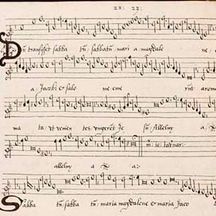
Verbum caro factum est (The Word became flesh), a six-voice Responsory for Christmas Day, is one of Sheppard’s most magnificent compositions. The music alternates between plainsong and polyphony, and the wall of sound that he creates is astonishing, particularly on the final chord of each polyphonic section, in which the treble divides into three parts.
Owen Rees wrote, “Sheppard’s Verbum caro is an exultant setting of the famous account of the Incarnation from the beginning of St John’s Gospel, and would have been sung at Matins on Christmas Day. Counteracting the duple metre maintained by the chant, Sheppard sets up triple rhythms in the free voices to achieve ‘natural’ declamation of such phrases as ‘cuius gloriam’, ‘quasi unigeniti’, and ‘plenum gratiae’. ”
I remember the first time that I sang Verbum caro, many years ago. I was transfixed from that first high B treble entry and easily got lost in the beautiful, flowing treble line of each verse. This is a thrilling piece to sing as well as to hear. As Robert Reigle has noted, “Sheppard’s music does not usually follow standard patterns of melodic repetition and harmonic progression; it sounds fresh in our 21st century, sometimes even avant-garde, embracing the freedom to employ non-standard dissonances that heighten emotional impact and maintain excitement.”
My classical music post for today is John Sheppard: Verbum caro factum est.


Leave a Reply