

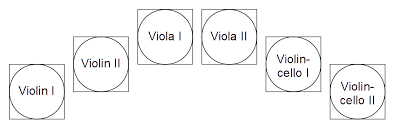
June is the sixth month in the Gregorian calendar, which is the calendar most in use throughout the world. This June, the Daily Classical Music Post will explore chamber music, choral music, and operatic sextets from the Renaissance to the 21st century.
Sextet in E-Flat Major, Op. 23, No. 1, G. 454: III. Minuetto – Trio I-III
The Italian Classical composer and cellist Luigi Boccherini (1743–1805) built on Joseph Haydn’s model of string chamber music, particularly the string quartet, by giving the cello a more prominent role, most likely because he performed many of his own works. He also developed his own type of string quintet, adding a second cello, mostly so he could play the music that he wrote without denying the cellist in the royal string quartet a place. While he was in the employ of the Infante Don Luis in Spain, he composed six string sextets, believed to be the first ones written for the combination of two violins, two violas, and two cellos. The sextets were composed in 1776 and first published in Paris in 1777.
Janet Horvath wrote, “Before Johannes Brahms, few pieces were written for strings without piano, other than string quartets. The exception was the Italian composer Luigi Boccherini who wrote two sets of six string sextets Opus 23 in 1776. They’re lovely and very likely the first sextets written. These works are melodically and harmonically inventive and largely unknown. An exceptional cellist, Boccherini took care to allow the cello a more prominent role rather than being relegated to a bass role, as he frequently played the first cello part in performances. In fact, Boccherini sometimes had to substitute for violinists, and he would play the violin part on his cello at the right pitch!”
The first sextet in the set, No. 1 in E-Flat major, is a joyful piece, and all six parts interact with each other throughout in an almost conversational way. The third movement, a minuet, has three trios—this somewhat unorthodox form is repeated in the other sextets—the last of which has some particularly florid and virtuosic cello writing. There is no Haydn-esque drama, but the addition of the second viola allows Boccherini to create a much richer and more resonant texture. The melodies are gentle, contemplative, and calming.
The sextets are among Boccherini’s best works, not as well known perhaps as the quintets, but every bit as beautiful and lyrical. John Quinn wrote, “If ever proof was needed that Boccherini was no poor country cousin to his contemporary celebrities, Haydn and Mozart, it can be found in these miraculously inventive, sonorous works.”
My classical music post for today is Luigi Boccherini: Sextet in E-Flat Major, Op. 23, No. 1: II. Minuetto – Trio I–III.


Leave a Reply