

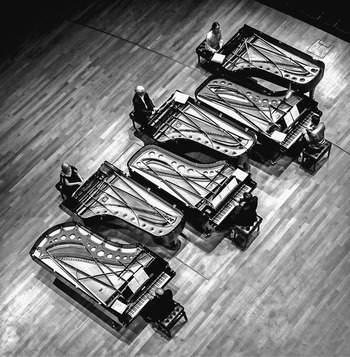
June is the sixth month in the Gregorian calendar, which is the calendar most in use throughout the world. This June, the Daily Classical Music Post will explore chamber music, choral music, and operatic sextets from the Renaissance to the 21st century.
The American composer Steve Reich (born 1938) pretty much defines classical music minimalism of the mid-20th century. Repetition, rhythm, and canons are hallmarks of his pieces. I feel like some of his music inspired trance; it’s great fun to listen to something like Music for 18 Musicians and try to figure out what the changes are and when they take place. These changes are part of phasing, a compositional technique that Reich made popular, in which the same part is played on two or more instruments in steady but not quite identical tempi. Gradually, the instruments shift out of unison, but after several changes, they eventually come back together in unison.
In 1973, Reich had an idea for a piece that would involve a group of pianists playing all of the pianos in a piano store. The working title for this piece was, unsurprisingly, Piano Store. Reich wrote, “The piece which actually resulted is a bit more modest in scope since too many pianos (especially if they are large grands) can begin to sound thick and unmanageable. Using six smaller grands made it possible to play the fast, rhythmically intricate kind of music I am drawn to while at the same time allowing the players to be physically close together so as to hear each other clearly.” And so Six Pianos was born.
Six Pianos begins with four pianists playing the same rhythmic pattern on different notes. Then the other two pianists enter, playing the same pattern but two beats out of phase. The piece, in duple time, is in three sections. The changes in each section are subtle; it’s fun to listen carefully to the piece to try to hear the changes, but it’s actually also fun to just let the piece wash over you as you relax into it. Yes, this definitely is trance music.
The French composer and pianist Christophe Chassol said in an interview, “Steve Reich is like a priest for me. I discovered Six Pianos when I was about 17, but it took time before I understood its austere beauty. You’re exploring a single chord as though you’re peeling a fruit, pressing the flesh, eating it. For me, playing Six Pianos is like doing sports; I have to practice and prepare for it. I use MIDI files alongside my keyboard, and I play it with jazz chords. I put warmth and pop into Six Pianos.”
Reich composed a variation of Six Pianos for marimbas (Six Marimbas, 1986), and other musicians have made arrangements including one for accordions (Six Accordions, 2010); I found a video of the latter arrangement on YouTube (Steve Reich / Six Accordions ライヒ:6台のアコーディオン), and all I can say is it has a certain je ne sais quoi (and believe me, I don’t).
My classical music post for today is Steve Reich: Six Pianos.


Leave a Reply