

June is the sixth month in the Gregorian calendar, which is the calendar most in use throughout the world. This June, the Daily Classical Music Post will explore chamber music, choral music, and operatic sextets from the Renaissance to the 21st century.
Oboe Sextet No. 2 in F Major, L. 274: III. Thema con variacioni
The Italian Classical composer Cayetano Brunetti (1744–1798) spent most of his working life in Spain, first as a violinist in the court of Carlos III and then as director of the royal ensemble formed for the court of Carlos IV, who had been Brunetti’s violin student and was an avid patron of music. Brunetti composed well over 400 works, mainly chamber music and symphonies for the royal chamber orchestra. Very little of his music was published during his lifetime, and he remained virtually unknown until the late 20th century.
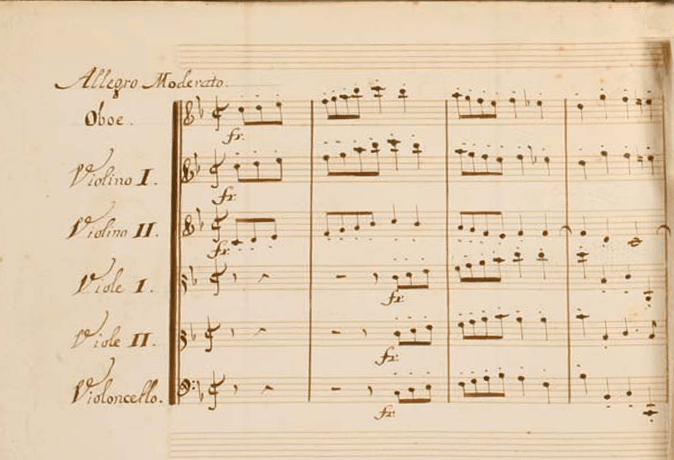
Brunetti’s six oboe sextets (L. 273–278) were composed between 1796 and 1798, probably prompted by the appointment of royal chamber oboist Gaspar Barli in 1796. As per the manuscripts, they were composed “per divertimento di S.M.C.” (for the amusement of His Catholic Majesty).
The unique instrumentation is what really makes these sextets stand out: oboe, two violins, two violas, and cello. This interesting combination gave Brunetti flexibility throughout, as he could have the two violins and the two violas play separately or together, and he could have the ensemble perform as a trio, as a quartet, as a quintet, or a sextet.
The third movement of Sextet No. 2 in F Major, L. 274, Thema con variacioni, is considered to be one of the highlights of the six sextets. It is a brilliant, complex, and virtuosic piece, with each performer given their own moment to shine. There is a theatricality about the way the performers interact with each other, perhaps revealing Brunetti’s interest in the 18th-century “sentimental comedy” theatre genre popular in Madrid. Some of the variations have an almost improvisatory quality, heightening the tension and emotion.
Raúl Angulo Díaz wrote, “One can notice in Brunetti the influence of Luigi Boccherini. . . . From Boccherini, Brunetti took several compositional strategies, such as, for example, the use of timbre, dynamics, and texture contrasts, as well as the virtuosic and high-pitched writing of the cello part. . . . Brunetti was noticeably influenced by Joseph Haydn’s music, which was then starting to be well known in Spain.” Although Brunetti’s music shows these as well as many other influences, he has a style all his own, and it is very sad that the vast majority of his music is lost.
My classical music post for today is Cayetano Brunetti: Oboe Sextet No. 2 in F Major, L. 274: III. Thema con variacioni.


Leave a Reply